AP 10th Class Electricity Solutions — పదో తరగతి భౌతిక శాస్త్రం విద్యుత్ పాఠంలోని అన్ని పాఠ్యపుస్తకం ప్రశ్నలకు జవాబులు. 23 In-text ప్రశ్నలు, 18 అభ్యాస ప్రశ్నలు (లెక్కలు అన్నీ దశలవారీగా), పరీక్షకు ముఖ్యమైన 1, 2, 4 మార్కుల ప్రశ్నలు, 10 ప్రశ్నల క్విజ్ ఒకే పేజీలో ఉన్నాయి.
ప్రతి జవాబు పరీక్షలో రాసే విధంగా ఇంగ్లీష్లో, కింద తెలుగు వివరణతో ఉంటుంది. సూత్రాలు, ప్రమాణాలు, శ్రేణి, సమాంతర సంధానాల తేడాలు పట్టికలుగా, సూత్రాల చార్ట్గా ఇచ్చాం. ముందు పాఠాల జవాబులు Light Reflection and Refraction, Human Eye and Colourful World లో ఉన్నాయి.
తర్వాతి Physics పాఠం జవాబులు వచ్చిన వెంటనే లింక్ రావాలంటే WhatsApp గ్రూప్లో చేరండి
ఈ పేజీలో: పాఠంలో ఏముంది | సూత్రాలు, ప్రమాణాలు | శ్రేణి vs సమాంతరం | In-text ప్రశ్నలు | అభ్యాస ప్రశ్నలు 1-18 | ముఖ్య ప్రశ్నలు | క్విజ్ | మార్కులు పోయే చోట్లు | FAQs
AP 10th Class Electricity Solutions — పాఠంలో ఏముంది
AP SCERT ఉపాధ్యాయ కరదీపిక ప్రకారం ఈ పాఠం సెప్టెంబర్లో చెబుతారు. ఓమ్ నియమం ప్రయోగం, నిరోధాల సంధానం లెక్కలు, విద్యుత్ సామర్థ్యం, శక్తి (kWh) లెక్కలు ఈ పాఠం నుంచి ఎక్కువగా అడుగుతారు.
| అంశం | ముఖ్య విషయాలు |
|---|---|
| విద్యుత్ ప్రవాహం, పొటెన్షియల్ భేదం | విద్యుదావేశం, ఆంపియర్, వోల్ట్, వలయ పటాలు (circuit diagram) |
| ఓమ్ నియమం, నిరోధం | V = IR, నిరోధం ఆధారపడే అంశాలు, విశిష్ట నిరోధం |
| నిరోధాల సంధానం | శ్రేణి, సమాంతర సంధానాలు, తుల్య నిరోధం |
| విద్యుత్ తాపన ఫలితం | జౌల్ నియమం H = I2Rt, ఉపయోగాలు (బల్బు, ఫ్యూజ్, ఇస్త్రీ పెట్టె) |
| విద్యుత్ సామర్థ్యం | P = VI, వాట్, కిలోవాట్ అవర్ (kWh) |
ఈ పాఠంలోని అన్ని సూత్రాలు ఒకే చోట 10th Class Physics Formulas in Telugu పేజీలో ఉన్నాయి.
విద్యుత్ సూత్రాలు, ప్రమాణాలు
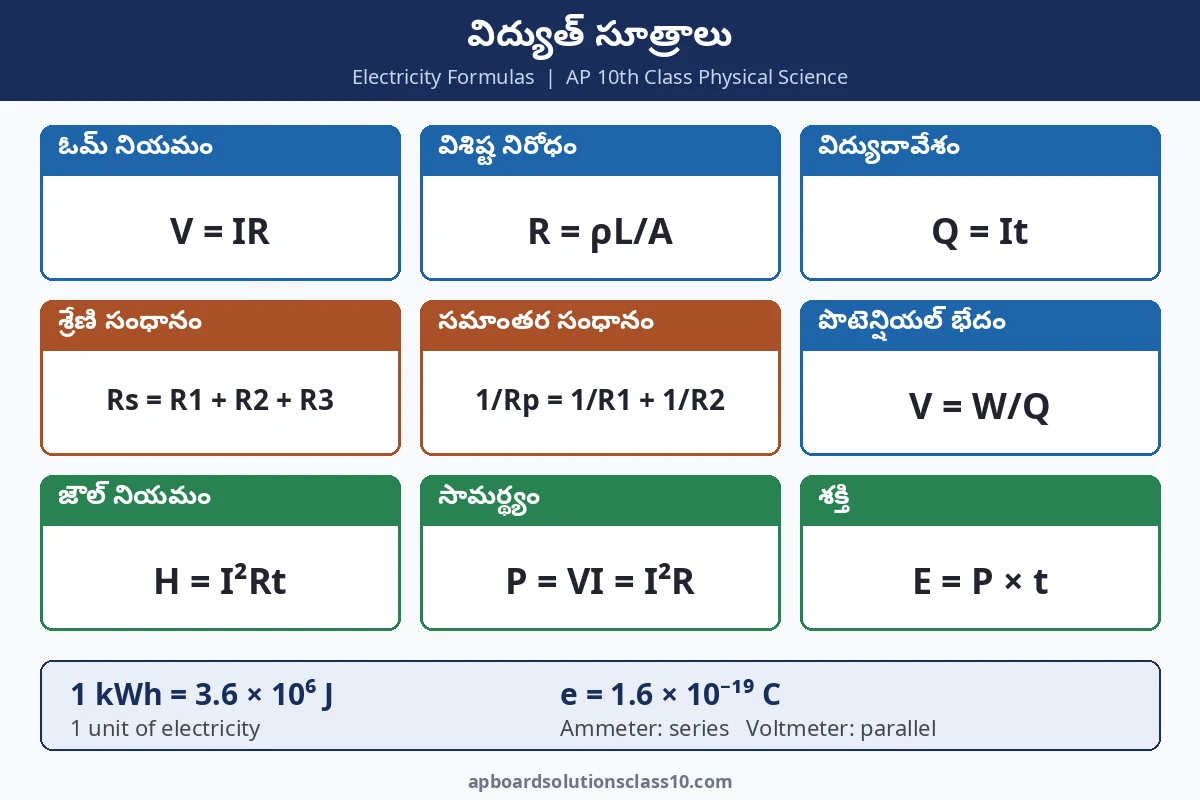
| రాశి | సూత్రం | SI ప్రమాణం |
|---|---|---|
| విద్యుదావేశం (Q) | Q = It | కూలుంబ్ (C) |
| విద్యుత్ ప్రవాహం (I) | I = Q/t | ఆంపియర్ (A) |
| పొటెన్షియల్ భేదం (V) | V = W/Q | వోల్ట్ (V) |
| నిరోధం (R) | R = V/I | ఓమ్ (Ω) |
| విశిష్ట నిరోధం (ρ) | R = ρL/A | ఓమ్ మీటర్ (Ω m) |
| ఉష్ణం (H) | H = I2Rt | జౌల్ (J) |
| సామర్థ్యం (P) | P = VI = I2R = V2/R | వాట్ (W) |
ఒక ఎలక్ట్రాన్ ఆవేశం 1.6 × 10⁻¹⁹ C. 1 kWh = 3.6 × 10⁶ J (ఇదే 1 యూనిట్ విద్యుత్).
శ్రేణి సంధానం, సమాంతర సంధానం — తేడాలు
| అంశం | శ్రేణి (Series) | సమాంతరం (Parallel) |
|---|---|---|
| విద్యుత్ ప్రవాహం | అన్నింటిలో ఒకటే | నిరోధాల మధ్య విడిపోతుంది |
| పొటెన్షియల్ భేదం | నిరోధాల మధ్య విడిపోతుంది | అన్నింటికీ ఒకటే |
| తుల్య నిరోధం | Rs = R1 + R2 + R3 | 1/Rp = 1/R1 + 1/R2 + 1/R3 |
| ఫలితం | అతిపెద్ద నిరోధం కంటే ఎక్కువ | అతిచిన్న నిరోధం కంటే తక్కువ |
| ఒక పరికరం ఆగితే | వలయం మొత్తం ఆగుతుంది | మిగతావి పనిచేస్తాయి |
అందుకే ఇళ్లలో పరికరాలను సమాంతరంగా కలుపుతారు.
AP 10th Class Electricity Solutions — In-text Questions
పాఠం మధ్యలో వచ్చే 23 ప్రశ్నలు. జవాబు చూడండి బటన్ నొక్కితే జవాబు కనిపిస్తుంది.
1. What does an electric circuit mean?
జవాబు చూడండి
తెలుగులో: విద్యుత్ ప్రవహించే మూసిన, అవిచ్ఛిన్న మార్గమే విద్యుత్ వలయం.
2. Define the unit of current.
జవాబు చూడండి
3. Calculate the number of electrons constituting one coulomb of charge.
జవాబు చూడండి
Number of electrons n = Q/e = 1/(1.6 × 10−19) = 6.25 × 10¹⁸.
4. Name a device that helps to maintain a potential difference across a conductor.
జవాబు చూడండి
5. What is meant by saying that the potential difference between two points is 1 V?
జవాబు చూడండి
6. How much energy is given to each coulomb of charge passing through a 6 V battery?
జవాబు చూడండి
7. On what factors does the resistance of a conductor depend?
జవాబు చూడండి
తెలుగులో: పొడవు, మందం (అడ్డుకోత వైశాల్యం), పదార్థ స్వభావం, ఉష్ణోగ్రత.
8. Will current flow more easily through a thick wire or a thin wire of the same material, when connected to the same source? Why?
జవాబు చూడండి
9. Let the resistance of an electrical component remain constant while the potential difference across its two ends decreases to half of its former value. What change will occur in the current through it?
జవాబు చూడండి
10. Why are coils of electric toasters and electric irons made of an alloy rather than a pure metal?
జవాబు చూడండి
తెలుగులో: మిశ్రమ లోహాలకు విశిష్ట నిరోధం ఎక్కువ, ఎక్కువ ఉష్ణోగ్రత వద్ద కూడా సులభంగా ఆక్సీకరణం చెందవు.
11. Use the resistivity table in the textbook to answer: (a) Which among iron and mercury is a better conductor? (b) Which material is the best conductor?
జవాబు చూడండి
(b) Silver, which has the lowest resistivity (1.60 × 10⁻⁸ Ω m).
తెలుగులో: విశిష్ట నిరోధం తక్కువ ఉన్నది మంచి వాహకం.
12. Draw a schematic diagram of a circuit consisting of a battery of three cells of 2 V each, a 5 Ω resistor, an 8 Ω resistor, a 12 Ω resistor and a plug key, all connected in series.
జవాబు చూడండి
తెలుగులో: శ్రేణి సంధానంలో ఒకే మార్గం ఉంటుంది. ఘటాల గుర్తులు సరిగ్గా (పొడవు గీత +, పొట్టి గీత −) గీయాలి.
13. Redraw the circuit above, putting in an ammeter to measure the current through the resistors and a voltmeter to measure the potential difference across the 12 Ω resistor. What would be the readings in the ammeter and the voltmeter?
జవాబు చూడండి
Total resistance R = 5 + 8 + 12 = 25 Ω; V = 3 × 2 = 6 V.
Ammeter reading I = V/R = 6/25 = 0.24 A.
Voltmeter reading V = IR = 0.24 × 12 = 2.88 V.
తెలుగులో: అమ్మీటర్ శ్రేణిలో, వోల్టుమీటర్ సమాంతరంగా కలపాలి.
14. Judge the equivalent resistance when the following are connected in parallel: (a) 1 Ω and 106 Ω (b) 1 Ω, 103 Ω and 106 Ω.
జవాబు చూడండి
(a) Slightly less than 1 Ω (about 0.999999 Ω).
(b) Also slightly less than 1 Ω (about 0.999 Ω).
15. An electric lamp of 100 Ω, a toaster of resistance 50 Ω and a water filter of resistance 500 Ω are connected in parallel to a 220 V source. What is the resistance of an electric iron connected to the same source that takes as much current as all three appliances, and what is the current through it?
జవాబు చూడండి
The iron must have resistance 31.25 Ω.
Current I = V/R = 220/31.25 = 7.04 A.
16. What are the advantages of connecting electrical devices in parallel with the battery instead of connecting them in series?
జవాబు చూడండి
17. How can three resistors of resistances 2 Ω, 3 Ω and 6 Ω be connected to give a total resistance of (a) 4 Ω (b) 1 Ω?
జవాబు చూడండి
(b) Connect all three in parallel: 1/R = 1/2 + 1/3 + 1/6 = (3 + 2 + 1)/6 = 1 ⇒ R = 1 Ω.
18. What is (a) the highest, (b) the lowest total resistance that can be secured by combinations of four coils of resistance 4 Ω, 8 Ω, 12 Ω and 24 Ω?
జవాబు చూడండి
(b) Lowest: all in parallel: 1/R = 1/4 + 1/8 + 1/12 + 1/24 = (6 + 3 + 2 + 1)/24 = 12/24 ⇒ R = 2 Ω.
19. Why does the cord of an electric heater not glow while the heating element does?
జవాబు చూడండి
20. Compute the heat generated while transferring 96000 coulomb of charge in one hour through a potential difference of 50 V.
జవాబు చూడండి
తెలుగులో: H = VIt, It = Q కాబట్టి H = VQ.
21. An electric iron of resistance 20 Ω takes a current of 5 A. Calculate the heat developed in 30 s.
జవాబు చూడండి
22. What determines the rate at which energy is delivered by a current?
జవాబు చూడండి
23. An electric motor takes 5 A from a 220 V line. Determine the power of the motor and the energy consumed in 2 h.
జవాబు చూడండి
Energy E = P × t = 1100 W × 2 h = 2200 Wh = 2.2 kWh.
In joules: 1100 × 7200 = 7.92 × 10⁶ J.
AP 10th Class Electricity Solutions — Exercise Questions and Answers
పాఠం చివరి 18 అభ్యాస ప్రశ్నలు. 1 నుంచి 4 బహుళైచ్ఛిక ప్రశ్నలు. లెక్కల్లో ఇచ్చినవి, సూత్రం, ప్రతిక్షేపణ, ప్రమాణంతో జవాబు రాయండి.
1. A piece of wire of resistance R is cut into five equal parts. These parts are then connected in parallel. If the equivalent resistance of this combination is R′, then the ratio R/R′ is (a) 1/25 (b) 1/5 (c) 5 (d) 25
జవాబు చూడండి
Each part = R/5. Five such parts in parallel: R′ = (R/5)/5 = R/25. So R/R′ = 25.
2. Which of the following terms does not represent electrical power in a circuit? (a) I2R (b) IR2 (c) VI (d) V2/R
జవాబు చూడండి
3. An electric bulb is rated 220 V and 100 W. When it is operated on 110 V, the power consumed will be (a) 100 W (b) 75 W (c) 50 W (d) 25 W
జవాబు చూడండి
R = V2/P = 2202/100 = 484 Ω. At 110 V: P = 1102/484 = 25 W.
4. Two conducting wires of the same material and of equal lengths and equal diameters are first connected in series and then in parallel across the same potential difference. The ratio of heat produced in series and parallel combinations would be (a) 1:2 (b) 2:1 (c) 1:4 (d) 4:1
జవాబు చూడండి
Series: 2R; parallel: R/2. With the same V, heat H = V2t/R, so Hs : Hp = (1/2R) : (2/R) = 1 : 4.
5. How is a voltmeter connected in the circuit to measure the potential difference between two points?
జవాబు చూడండి
తెలుగులో: వోల్టుమీటర్ ఎప్పుడూ సమాంతరంగా కలపాలి.
6. A copper wire has diameter 0.5 mm and resistivity of 1.6 × 10⁻⁸ Ω m. What will be the length of this wire to make its resistance 10 Ω? How much does the resistance change if the diameter is doubled?
జవాబు చూడండి
A = πr2 = 3.14 × (0.25 × 10−3)2 = 1.96 × 10⁻⁷ m2.
L = RA/ρ = (10 × 1.96 × 10−7)/(1.6 × 10−8) = 122.7 m (about 123 m).
If the diameter is doubled, the area becomes 4 times, so the resistance becomes 1/4: 10/4 = 2.5 Ω. The resistance decreases by 7.5 Ω.
తెలుగులో: వ్యాసం రెట్టింపు అయితే వైశాల్యం 4 రెట్లు, నిరోధం 1/4 వంతు.
7. The values of current I flowing in a given resistor for the corresponding values of potential difference V across it are: I (A) = 0.5, 1.0, 2.0, 3.0, 4.0 and V (V) = 1.6, 3.4, 6.7, 10.2, 13.2. Plot a graph between V and I and calculate the resistance of the resistor.
జవాబు చూడండి
Resistance = slope of the V–I graph = (13.2 − 1.6)/(4.0 − 0.5) = 11.6/3.5 = 3.3 Ω (approximately).
తెలుగులో: గ్రాఫ్ సరళరేఖ, దాని వాలు (slope) నిరోధానికి సమానం.
8. When a 12 V battery is connected across an unknown resistor, there is a current of 2.5 mA in the circuit. Find the value of the resistance of the resistor.
జవాబు చూడండి
R = V/I = 12/(2.5 × 10−3) = 4800 Ω = 4.8 kΩ.
తెలుగులో: mA ను A లోకి మార్చడం మర్చిపోవద్దు.
9. A battery of 9 V is connected in series with resistors of 0.2 Ω, 0.3 Ω, 0.4 Ω, 0.5 Ω and 12 Ω. How much current would flow through the 12 Ω resistor?
జవాబు చూడండి
I = V/R = 9/13.4 = 0.67 A.
In series the same current flows through every resistor, so the current through 12 Ω is 0.67 A.
10. How many 176 Ω resistors (in parallel) are required to carry 5 A on a 220 V line?
జవాబు చూడండి
For n equal resistors in parallel: R = 176/n ⇒ 44 = 176/n ⇒ n = 4.
Four resistors are needed.
11. Show how you would connect three resistors, each of resistance 6 Ω, so that the combination has a resistance of (i) 9 Ω (ii) 4 Ω.
జవాబు చూడండి
(ii) Connect two resistors in series (6 + 6 = 12 Ω) and connect this combination in parallel with the third: (12 × 6)/(12 + 6) = 72/18 = 4 Ω.
12. Several electric bulbs designed to be used on a 220 V supply line are rated 10 W. How many lamps can be connected in parallel across the two wires of the 220 V line if the maximum allowable current is 5 A?
జవాబు చూడండి
Number of lamps = 1100/10 = 110.
13. A hot plate of an electric oven connected to a 220 V line has two resistance coils A and B, each of 24 Ω resistance, which may be used separately, in series, or in parallel. What are the currents in the three cases?
జవాబు చూడండి
In series: R = 24 + 24 = 48 Ω, I = 220/48 = 4.58 A.
In parallel: R = 24/2 = 12 Ω, I = 220/12 = 18.33 A.
14. Compare the power used in the 2 Ω resistor in each of the following circuits: (i) a 6 V battery in series with 1 Ω and 2 Ω resistors, and (ii) a 4 V battery in parallel with 12 Ω and 2 Ω resistors.
జవాబు చూడండి
(ii) In parallel, the 2 Ω resistor gets the full 4 V. P = V2/R = 42/2 = 8 W.
The power used in the 2 Ω resistor is the same (8 W) in both cases.
15. Two lamps, one rated 100 W at 220 V and the other 60 W at 220 V, are connected in parallel to the electric mains supply. What current is drawn from the line if the supply voltage is 220 V?
జవాబు చూడండి
I = P/V = 160/220 = 0.73 A.
16. Which uses more energy, a 250 W TV set in 1 hour, or a 1200 W toaster in 10 minutes?
జవాబు చూడండి
Toaster: E = 1200 × 600 = 7.2 × 10⁵ J.
The TV set uses more energy.
17. An electric heater of resistance 8 Ω draws 15 A from the service mains for 2 hours. Calculate the rate at which heat is developed in the heater.
జవాబు చూడండి
తెలుగులో: ఉష్ణం ఉత్పత్తి రేటు అంటే సామర్థ్యం; సమయం (2 h) ఇక్కడ అవసరం లేదు.
18. Explain the following: (a) Why is tungsten used almost exclusively for the filament of electric lamps? (b) Why are the conductors of electric heating devices, such as bread-toasters and electric irons, made of an alloy rather than a pure metal? (c) Why is the series arrangement not used for domestic circuits? (d) How does the resistance of a wire vary with its area of cross-section? (e) Why are copper and aluminium wires usually employed for electricity transmission?
జవాబు చూడండి
(b) Alloys have higher resistivity than pure metals and do not oxidise easily at high temperatures.
(c) In series, the voltage is shared, the same current flows through all devices, and if one device fails the whole circuit stops. Devices cannot be switched independently.
(d) Resistance is inversely proportional to the area of cross-section (R ∝ 1/A). A thicker wire has less resistance.
(e) Copper and aluminium have very low resistivity, so they are good conductors and waste little energy as heat.
10th Class Electricity Important Questions
పాఠ్యపుస్తకం ప్రశ్నలు కాకుండా, పరీక్షల్లో తరచూ వచ్చే రూపంలో మేము తయారు చేసిన ప్రశ్నలు.
1 మార్కు ప్రశ్నలు
1. What is the SI unit of resistivity?
జవాబు చూడండి
2. How many joules make 1 kWh?
జవాబు చూడండి
3. How is an ammeter connected in a circuit?
జవాబు చూడండి
4. What is the commercial unit of electrical energy?
జవాబు చూడండి
2 మార్కుల ప్రశ్నలు
1. State Ohm’s law.
జవాబు చూడండి
2. State Joule’s law of heating.
జవాబు చూడండి
3. What is an electric fuse? How does it work?
జవాబు చూడండి
4. A bulb is marked 60 W, 220 V. What does this mean? Find its resistance.
జవాబు చూడండి
R = V2/P = 2202/60 = 48400/60 = 806.7 Ω.
4 మార్కుల ప్రశ్నలు
1. Describe an experiment to verify Ohm’s law.
జవాబు చూడండి
Procedure: connect the cells, key, ammeter and the wire XY in series, and the voltmeter in parallel across XY. First use one cell and note the ammeter reading I and voltmeter reading V. Repeat with two, three and four cells.
Observation: calculate V/I for each set. The ratio is the same each time.
Conclusion: V/I is constant, i.e. V ∝ I. A graph of V against I is a straight line through the origin. This verifies Ohm’s law.
తెలుగులో: పట్టిక (V, I, V/I), సరళరేఖ గ్రాఫ్, వలయ పటం మూడూ రాస్తే పూర్తి మార్కులు.
2. Derive the expression for the equivalent resistance of three resistors connected in series.
జవాబు చూడండి
By Ohm’s law V1 = IR1, V2 = IR2, V3 = IR3, and for the combination V = IRs.
So IRs = IR1 + IR2 + IR3 ⇒ Rs = R1 + R2 + R3.
3. Derive the expression for the equivalent resistance of three resistors connected in parallel.
జవాబు చూడండి
By Ohm’s law I1 = V/R1, I2 = V/R2, I3 = V/R3, and I = V/Rp.
So V/Rp = V/R1 + V/R2 + V/R3 ⇒ 1/Rp = 1/R1 + 1/R2 + 1/R3.
4. A house uses four 40 W bulbs for 5 hours a day and a 1000 W heater for 2 hours a day. Find the energy used in 30 days and the cost at Rs 5 per unit.
జవాబు చూడండి
Heater: 1000 × 2 = 2000 Wh per day.
Total per day = 2800 Wh = 2.8 kWh.
In 30 days = 2.8 × 30 = 84 kWh (84 units).
Cost = 84 × 5 = Rs 420.
తెలుగులో: Wh ను 1000 తో భాగిస్తే kWh (యూనిట్లు) వస్తాయి.
Electricity క్విజ్ — 10 ప్రశ్నలు
జవాబు చూసి, మీది సరైతేనే టిక్ పెట్టండి. కింది బార్లో 10 కి మీ స్కోర్ కనిపిస్తుంది.
1. SI unit of electric current:
(A) volt (B) ohm (C) ampere (D) coulomb [1 మార్కు]
జవాబు చూడండి
2. A wire of resistance R is cut into 5 equal parts and joined in parallel. R/R′ is:
(A) 1/25 (B) 1/5 (C) 5 (D) 25 [1 మార్కు]
జవాబు చూడండి
3. Which does NOT represent electric power?
(A) I2R (B) IR2 (C) VI (D) V2/R [1 మార్కు]
జవాబు చూడండి
4. A 220 V, 100 W bulb operated at 110 V consumes:
(A) 100 W (B) 75 W (C) 50 W (D) 25 W [1 మార్కు]
జవాబు చూడండి
5. A voltmeter is connected in a circuit:
(A) in series (B) in parallel (C) either way (D) not needed [1 మార్కు]
జవాబు చూడండి
6. 1 kWh is equal to:
(A) 3.6 × 10³ J (B) 3.6 × 10⁶ J (C) 1000 J (D) 3600 J [1 మార్కు]
జవాబు చూడండి
7. Lowest resistance from 4 Ω, 8 Ω, 12 Ω, 24 Ω:
(A) 1 Ω (B) 2 Ω (C) 4 Ω (D) 48 Ω [1 మార్కు]
జవాబు చూడండి
8. Filament of an electric bulb is made of:
(A) copper (B) nichrome (C) tungsten (D) aluminium [1 మార్కు]
జవాబు చూడండి
9. Heat produced when 5 A flows through 20 Ω for 30 s:
(A) 3000 J (B) 1500 J (C) 15000 J (D) 600 J [1 మార్కు]
జవాబు చూడండి
10. Number of electrons in 1 coulomb of charge:
(A) 6.25 × 10¹⁸ (B) 1.6 × 10¹⁹ (C) 6.25 × 10¹⁹ (D) 1.6 × 10⁻¹⁹ [1 మార్కు]
జవాబు చూడండి
ఈ పాఠంలో మార్కులు ఎక్కడ పోతాయి
- mA, mm వంటి ప్రమాణాలను A, m లోకి మార్చకుండా నేరుగా సూత్రంలో పెట్టడం.
- సమాంతర సంధానంలో 1/R విలువ కనుక్కుని, దాన్ని తిరగేయకుండా (reciprocal తీసుకోకుండా) జవాబుగా రాయడం.
- అమ్మీటర్ సమాంతరంగా, వోల్టుమీటర్ శ్రేణిలో అని తారుమారు చేయడం.
- R = ρL/A లెక్కలో వ్యాసం ఇస్తే వ్యాసార్థం (r = d/2) తీసుకోకపోవడం.
- వలయ పటంలో ఘటం, కీ, నిరోధం గుర్తులు తప్పుగా గీయడం, జవాబుకు ప్రమాణం (A, V, Ω, W, J) రాయకపోవడం.
తర్వాత ఏం చదవాలి
- 10th Class Physics Formulas in Telugu — అన్ని Physics సూత్రాలు
- AP 10th Class Human Eye and Colourful World Solutions — మానవ నేత్రం పాఠం జవాబులు
- AP Board Solutions Class 10 Physics Important Questions — మరిన్ని ముఖ్య ప్రశ్నలు
- AP 10th Class SA1 Physical Science Question Paper 2026-27 — SA1 సాధన పేపర్
FAQs
AP 10th Class Electricity పాఠం ఏ నెలలో చెబుతారు?
AP SCERT ఉపాధ్యాయ కరదీపిక ప్రకారం సెప్టెంబర్లో. మానవ నేత్రం పాఠం తర్వాత వస్తుంది.
ఈ పాఠంలో ఎన్ని ప్రశ్నలు ఉన్నాయి?
పాఠం చివర 18 అభ్యాస ప్రశ్నలు, పాఠం మధ్యలో 23 In-text ప్రశ్నలు. అన్నింటికీ జవాబులు ఈ పేజీలో ఉన్నాయి.
ఓమ్ నియమం ఏమిటి?
స్థిర ఉష్ణోగ్రత వద్ద వాహకం గుండా ప్రవహించే విద్యుత్ ప్రవాహం దాని రెండు చివరల మధ్య పొటెన్షియల్ భేదానికి అనులోమానుపాతంలో ఉంటుంది. V = IR.
నిరోధం దేనిపై ఆధారపడుతుంది?
వాహకం పొడవు, అడ్డుకోత వైశాల్యం, పదార్థ స్వభావం, ఉష్ణోగ్రత. R = ρL/A.
ఇళ్లలో పరికరాలను సమాంతరంగా ఎందుకు కలుపుతారు?
ప్రతి పరికరానికి పూర్తి వోల్టేజ్ అందుతుంది, ఒకటి ఆగినా మిగతావి పనిచేస్తాయి, ప్రతిదాన్ని విడిగా ఆన్/ఆఫ్ చేయవచ్చు.
1 యూనిట్ విద్యుత్ అంటే ఎంత?
1 యూనిట్ = 1 kWh = 3.6 × 10⁶ జౌల్స్. 1000 W పరికరం 1 గంట పనిచేస్తే 1 యూనిట్ ఖర్చవుతుంది.
బల్బు ఫిలమెంట్కు టంగ్స్టన్ ఎందుకు?
టంగ్స్టన్ ద్రవీభవన స్థానం చాలా ఎక్కువ (సుమారు 3380 °C), కరగకుండా తెల్లగా వెలుగుతుంది.
ఈ జవాబులు తెలుగు మీడియం విద్యార్థులకు పనికొస్తాయా?
అవును. ప్రతి ముఖ్య జవాబు కింద తెలుగు వివరణ ఉంది. సూత్రాలు, లెక్కలు రెండు మీడియంలలోనూ ఒకటే.
SA1 లో ఈ పాఠం వస్తుందా?
ఇది సెప్టెంబర్ పాఠం. SA1 లో ఏ పాఠాలు ఉంటాయో AP SA1 Syllabus 2026-27 పేజీలో చూడండి. SSC పరీక్షకు ఈ పాఠం తప్పనిసరి.
తర్వాతి పాఠం జవాబులు ఎప్పుడు?
తర్వాత Magnetic Effects of Electric Current (విద్యుత్ ప్రవాహ అయస్కాంత ఫలితాలు) పాఠం జవాబుల పేజీ వస్తుంది.
Official Sources
పాఠాల జాబితా, నెలవారీ ప్రణాళిక: AP SCERT పదో తరగతి భౌతిక శాస్త్రం ఉపాధ్యాయ కరదీపిక (Teacher’s Handbook), పాఠశాల విద్యాశాఖ ఆంధ్రప్రదేశ్. పాఠ్యపుస్తకాలు పాఠశాల విద్యాశాఖ సైట్లో లభిస్తాయి. జవాబులు మా సొంత మాటల్లో రాశాం.