AP 10th Class Light Reflection and Refraction Solutions — పదో తరగతి భౌతిక శాస్త్రం కాంతి – పరావర్తనం, వక్రీభవనం పాఠంలోని అన్ని పాఠ్యపుస్తకం ప్రశ్నలకు జవాబులు. 14 In-text ప్రశ్నలు, 17 అభ్యాస ప్రశ్నలు (లెక్కలు అన్నీ దశలవారీగా), పరీక్షకు ముఖ్యమైన 1, 2, 4 మార్కుల ప్రశ్నలు, 10 ప్రశ్నల క్విజ్ ఒకే పేజీలో ఉన్నాయి.
ప్రతి జవాబు పరీక్షలో రాసే విధంగా ఇంగ్లీష్లో, కింద తెలుగు వివరణతో ఉంటుంది. ప్రతిబింబ ఏర్పాటు పట్టికలు, దర్పణ, కటక సూత్రాల చార్ట్ కూడా ఇచ్చాం. రసాయన శాస్త్రం పాఠాల జవాబులు Chemical Reactions, Acids Bases and Salts, Metals and Non-metals, Carbon and its Compounds లో ఉన్నాయి.
తర్వాతి Physics పాఠాల జవాబులు వచ్చిన వెంటనే లింక్ రావాలంటే WhatsApp గ్రూప్లో చేరండి
ఈ పేజీలో: పాఠంలో ఏముంది | సూత్రాలు, సంజ్ఞా సంప్రదాయం | ప్రతిబింబ పట్టికలు | In-text ప్రశ్నలు | అభ్యాస ప్రశ్నలు 1-17 | ముఖ్య ప్రశ్నలు | క్విజ్ | మార్కులు పోయే చోట్లు | FAQs
AP 10th Class Light Reflection and Refraction Solutions — పాఠంలో ఏముంది
AP SCERT ఉపాధ్యాయ కరదీపిక ప్రకారం ఈ పాఠం జూలైలో చెబుతారు. కిరణ చిత్రాలు, దర్పణ సూత్రం, కటక సూత్రం లెక్కలు, వక్రీభవన గుణకం ఈ పాఠం నుంచి ఎక్కువగా అడుగుతారు.
| విభాగం | అంశం |
|---|---|
| 9.1 | కాంతి పరావర్తనం: పరావర్తన నియమాలు, సమతల దర్పణం |
| 9.2 | గోళాకార దర్పణాలు: పుటాకార, కుంభాకార దర్పణాలు, కిరణ చిత్రాలు, ఉపయోగాలు, సంజ్ఞా సంప్రదాయం, దర్పణ సూత్రం, ఆవర్ధనం |
| 9.3 | కాంతి వక్రీభవనం: దీర్ఘచతురస్రాకార గాజు దిమ్మె, వక్రీభవన గుణకం, గోళాకార కటకాలు, కటక సూత్రం, కటక సామర్థ్యం |
ఈ పాఠంలోని అన్ని సూత్రాలు ఒకే చోట 10th Class Physics Formulas in Telugu పేజీలో ఉన్నాయి.
దర్పణ, కటక సూత్రాలు, సంజ్ఞా సంప్రదాయం
లెక్కల్లో మార్కులు పోయేది ఎక్కువగా గుర్తుల (+, −) దగ్గరే. అన్ని దూరాలు ధ్రువం (దర్పణం) లేదా దృక్ కేంద్రం (కటకం) నుంచి కొలవాలి. పతన కాంతి వెళ్లే దిశలో దూరం ధనాత్మకం, వ్యతిరేక దిశలో రుణాత్మకం. వస్తువును ఎప్పుడూ ఎడమవైపు పెడతాం కాబట్టి u ఎప్పుడూ రుణాత్మకం.
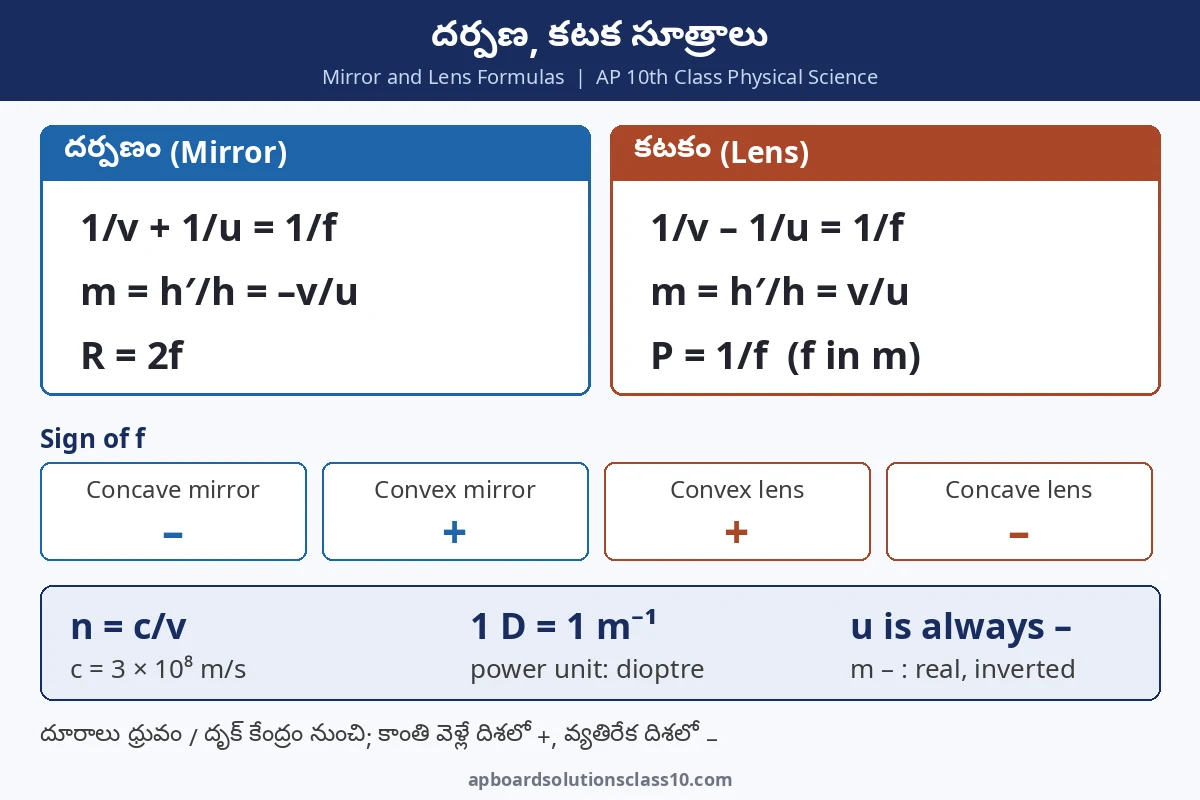
| సూత్రం | దర్పణం | కటకం |
|---|---|---|
| ప్రధాన సూత్రం | 1/v + 1/u = 1/f | 1/v − 1/u = 1/f |
| ఆవర్ధనం m | h′/h = −v/u | h′/h = v/u |
| f గుర్తు | పుటాకారం −, కుంభాకారం + | కుంభాకారం +, పుటాకారం − |
ఇంకా: R = 2f, వక్రీభవన గుణకం n = c/v, కటక సామర్థ్యం P = 1/f (f మీటర్లలో, ప్రమాణం డయాప్టర్ D). m రుణాత్మకం అయితే నిజ, తలకిందుల ప్రతిబింబం; ధనాత్మకం అయితే మిథ్యా, నిటారు ప్రతిబింబం.
ప్రతిబింబ ఏర్పాటు పట్టికలు
పుటాకార దర్పణం (Concave Mirror)
| వస్తువు స్థానం | ప్రతిబింబ స్థానం | పరిమాణం, స్వభావం |
|---|---|---|
| అనంత దూరం | F వద్ద | చాలా చిన్నది (బిందువు), నిజ, తలకిందులు |
| C కి ఆవల | F, C మధ్య | చిన్నది, నిజ, తలకిందులు |
| C వద్ద | C వద్ద | సమాన పరిమాణం, నిజ, తలకిందులు |
| C, F మధ్య | C కి ఆవల | పెద్దది, నిజ, తలకిందులు |
| F వద్ద | అనంత దూరం | చాలా పెద్దది, నిజ, తలకిందులు |
| P, F మధ్య | దర్పణం వెనుక | పెద్దది, మిథ్యా, నిటారు |
కుంభాకార దర్పణం: వస్తువు ఎక్కడ ఉన్నా ప్రతిబింబం దర్పణం వెనుక P, F మధ్య, చిన్నది, మిథ్యా, నిటారుగా ఉంటుంది.
కుంభాకార కటకం (Convex Lens)
| వస్తువు స్థానం | ప్రతిబింబ స్థానం | పరిమాణం, స్వభావం |
|---|---|---|
| అనంత దూరం | F2 వద్ద | చాలా చిన్నది, నిజ, తలకిందులు |
| 2F1 కి ఆవల | F2, 2F2 మధ్య | చిన్నది, నిజ, తలకిందులు |
| 2F1 వద్ద | 2F2 వద్ద | సమాన పరిమాణం, నిజ, తలకిందులు |
| F1, 2F1 మధ్య | 2F2 కి ఆవల | పెద్దది, నిజ, తలకిందులు |
| F1 వద్ద | అనంత దూరం | చాలా పెద్దది, నిజ, తలకిందులు |
| F1, O మధ్య | వస్తువు ఉన్న వైపే | పెద్దది, మిథ్యా, నిటారు |
పుటాకార కటకం: వస్తువు ఎక్కడ ఉన్నా ప్రతిబింబం వస్తువు ఉన్న వైపే, F1, O మధ్య, చిన్నది, మిథ్యా, నిటారుగా ఉంటుంది.
AP 10th Class Light Reflection and Refraction Solutions — In-text Questions
పాఠం మధ్యలో వచ్చే 14 ప్రశ్నలు. జవాబు చూడండి బటన్ నొక్కితే జవాబు కనిపిస్తుంది.
1. Define the principal focus of a concave mirror.
జవాబు చూడండి
తెలుగులో: ప్రధాన అక్షానికి సమాంతర కిరణాలు పుటాకార దర్పణం నుంచి పరావర్తనం చెంది కలిసే బిందువు నాభి.
2. The radius of curvature of a spherical mirror is 20 cm. What is its focal length?
జవాబు చూడండి
3. Name a mirror that can give an erect and enlarged image of an object.
జవాబు చూడండి
తెలుగులో: వస్తువు P, F మధ్య ఉంటే పుటాకార దర్పణం నిటారు, పెద్ద ప్రతిబింబం ఇస్తుంది.
4. Why do we prefer a convex mirror as a rear-view mirror in vehicles?
జవాబు చూడండి
తెలుగులో: కుంభాకార దర్పణం ఎప్పుడూ నిటారు, చిన్న ప్రతిబింబం ఇస్తుంది, వెనుక ఎక్కువ ప్రాంతం కనిపిస్తుంది.
5. Find the focal length of a convex mirror whose radius of curvature is 32 cm.
జవాబు చూడండి
6. A concave mirror produces a three times magnified real image of an object placed at 10 cm in front of it. Where is the image located?
జవాబు చూడండి
m = −v/u ⇒ −3 = −v/(−10) ⇒ v = −30 cm.
The image is 30 cm in front of the mirror (on the same side as the object).
తెలుగులో: నిజ ప్రతిబింబం తలకిందులు కాబట్టి m కి రుణ గుర్తు పెట్టాలి.
7. A ray of light travelling in air enters obliquely into water. Does the light ray bend towards the normal or away from the normal? Why?
జవాబు చూడండి
తెలుగులో: విరళ యానకం నుంచి సాంద్ర యానకంలోకి వెళ్తే కాంతి వేగం తగ్గి లంబం వైపు వంగుతుంది.
8. Light enters from air to glass having refractive index 1.50. What is the speed of light in the glass? The speed of light in vacuum is 3 × 10⁸ m s−1.
జవాబు చూడండి
9. From the refractive index table in the textbook, find the medium with the highest optical density and the medium with the lowest optical density.
జవాబు చూడండి
Lowest optical density: air (refractive index 1.0003).
తెలుగులో: వక్రీభవన గుణకం ఎక్కువ అయితే దృశా సాంద్రత ఎక్కువ.
10. You are given kerosene, turpentine and water. In which of these does light travel fastest?
జవాబు చూడండి
తెలుగులో: వక్రీభవన గుణకం తక్కువ ఉన్న యానకంలో కాంతి వేగం ఎక్కువ.
11. The refractive index of diamond is 2.42. What is the meaning of this statement?
జవాబు చూడండి
12. Define 1 dioptre of power of a lens.
జవాబు చూడండి
13. A convex lens forms a real and inverted image of a needle at a distance of 50 cm from it. Where is the needle placed in front of the lens if the image is equal to the size of the object? Also find the power of the lens.
జవాబు చూడండి
1/f = 1/v − 1/u = 1/50 + 1/50 = 2/50 ⇒ f = 25 cm = 0.25 m.
P = 1/f = 1/0.25 = +4 D.
The needle is 50 cm in front of the lens; power is +4 D.
తెలుగులో: సమాన పరిమాణ నిజ ప్రతిబింబం అంటే వస్తువు 2F వద్ద ఉంది.
14. Find the power of a concave lens of focal length 2 m.
జవాబు చూడండి
AP 10th Class Light Reflection and Refraction Solutions — Exercise Questions and Answers
పాఠం చివరి 17 అభ్యాస ప్రశ్నలు. 1 నుంచి 6 బహుళైచ్ఛిక ప్రశ్నలు. లెక్కల్లో ముందు ఇచ్చినవి (given), సూత్రం, ప్రతిక్షేపణ, జవాబు క్రమంలో రాయండి.
1. Which one of the following materials cannot be used to make a lens? (a) Water (b) Glass (c) Plastic (d) Clay
జవాబు చూడండి
2. The image formed by a concave mirror is observed to be virtual, erect and larger than the object. Where should the position of the object be? (a) Between the principal focus and the centre of curvature (b) At the centre of curvature (c) Beyond the centre of curvature (d) Between the pole of the mirror and its principal focus
జవాబు చూడండి
3. Where should an object be placed in front of a convex lens to get a real image of the size of the object? (a) At the principal focus of the lens (b) At twice the focal length (c) At infinity (d) Between the optical centre of the lens and its principal focus
జవాబు చూడండి
4. A spherical mirror and a thin spherical lens have each a focal length of −15 cm. The mirror and the lens are likely to be (a) both concave (b) both convex (c) the mirror is concave and the lens is convex (d) the mirror is convex, but the lens is concave
జవాబు చూడండి
5. No matter how far you stand from a mirror, your image appears erect. The mirror is likely to be (a) only plane (b) only concave (c) only convex (d) either plane or convex
జవాబు చూడండి
6. Which of the following lenses would you prefer to use while reading small letters found in a dictionary? (a) A convex lens of focal length 50 cm (b) A concave lens of focal length 50 cm (c) A convex lens of focal length 5 cm (d) A concave lens of focal length 5 cm
జవాబు చూడండి
7. We wish to obtain an erect image of an object, using a concave mirror of focal length 15 cm. What should be the range of distance of the object from the mirror? What is the nature of the image? Is the image larger or smaller than the object? Draw a ray diagram.
జవాబు చూడండి
The image is virtual and erect, formed behind the mirror, and larger than the object.
Ray diagram: draw one ray from the top of the object parallel to the principal axis, which reflects through F; draw a second ray towards the mirror along the line from C, which reflects back on itself. The reflected rays spread out; extend them backwards with dotted lines behind the mirror. They meet at the top of an enlarged, erect image.
తెలుగులో: కిరణ చిత్రంలో పరావర్తన కిరణాలను దర్పణం వెనుకకు చుక్కల గీతలతో పొడిగించాలి. అవి కలిసే చోట మిథ్యా ప్రతిబింబం.
8. Name the type of mirror used in the following situations: (a) Headlights of a car (b) Side/rear-view mirror of a vehicle (c) Solar furnace. Support your answer with reason.
జవాబు చూడండి
(b) Convex mirror. It gives an erect, diminished image and a wide field of view.
(c) Concave mirror. It collects sunlight and concentrates it at its focus, producing a very high temperature.
తెలుగులో: హెడ్లైట్, సోలార్ ఫర్నేస్: పుటాకార దర్పణం. వెనుక చూసే అద్దం: కుంభాకార దర్పణం.
9. One-half of a convex lens is covered with a black paper. Will this lens produce a complete image of the object? Verify your answer experimentally. Explain your observations.
జవాబు చూడండి
Experiment: place a lighted candle in front of a convex lens fixed on a stand and get a sharp image on a screen. Now cover the lower half of the lens with black paper. The full image of the candle is still seen on the screen, only dimmer.
Reason: rays from every point of the object still pass through the uncovered half and meet at the image. Only the amount of light reaching the image is reduced.
తెలుగులో: కటకంలో సగం కప్పినా పూర్తి ప్రతిబింబం వస్తుంది, ప్రకాశం మాత్రమే తగ్గుతుంది.
10. An object 5 cm in length is held 25 cm away from a converging lens of focal length 10 cm. Draw the ray diagram and find the position, size and the nature of the image formed.
జవాబు చూడండి
1/v = 1/f + 1/u = 1/10 − 1/25 = (5 − 2)/50 = 3/50 ⇒ v = +16.7 cm.
m = v/u = 16.7/(−25) = −0.67; h′ = m × h = −0.67 × 5 = −3.3 cm.
The image is formed 16.7 cm on the other side of the lens. It is real, inverted and diminished (3.3 cm).
Ray diagram: the object is beyond 2F1, so the image forms between F2 and 2F2.
తెలుగులో: కటక సూత్రం 1/v − 1/u = 1/f లో u = −25 పెట్టడం మర్చిపోవద్దు.
11. A concave lens of focal length 15 cm forms an image 10 cm from the lens. How far is the object placed from the lens? Draw the ray diagram.
జవాబు చూడండి
1/u = 1/v − 1/f = −1/10 + 1/15 = (−3 + 2)/30 = −1/30 ⇒ u = −30 cm.
The object is placed 30 cm in front of the lens.
Ray diagram: a ray parallel to the axis diverges after refraction and appears to come from F1; a ray through the optical centre goes straight. Their backward extensions meet at the virtual image.
తెలుగులో: పుటాకార కటకంలో f, v రెండూ రుణాత్మకం.
12. An object is placed at a distance of 10 cm from a convex mirror of focal length 15 cm. Find the position and nature of the image.
జవాబు చూడండి
1/v = 1/f − 1/u = 1/15 + 1/10 = (2 + 3)/30 = 5/30 ⇒ v = +6 cm.
m = −v/u = −6/(−10) = +0.6.
The image is 6 cm behind the mirror. It is virtual, erect and diminished.
తెలుగులో: v ధనాత్మకం అంటే ప్రతిబింబం దర్పణం వెనుక.
13. The magnification produced by a plane mirror is +1. What does this mean?
జవాబు చూడండి
14. An object 5.0 cm in length is placed at a distance of 20 cm in front of a convex mirror of radius of curvature 30 cm. Find the position of the image, its nature and size.
జవాబు చూడండి
1/v = 1/f − 1/u = 1/15 + 1/20 = (4 + 3)/60 = 7/60 ⇒ v = 60/7 = +8.6 cm.
m = −v/u = −(60/7)/(−20) = 3/7 = +0.43; h′ = (3/7) × 5 = +2.1 cm.
The image is 8.6 cm behind the mirror. It is virtual, erect and diminished (2.1 cm).
15. An object of size 7.0 cm is placed at 27 cm in front of a concave mirror of focal length 18 cm. At what distance from the mirror should a screen be placed so that a sharp focused image can be obtained? Find the size and the nature of the image.
జవాబు చూడండి
1/v = 1/f − 1/u = −1/18 + 1/27 = (−3 + 2)/54 = −1/54 ⇒ v = −54 cm.
The screen must be placed 54 cm in front of the mirror.
m = −v/u = −(−54)/(−27) = −2; h′ = −2 × 7 = −14 cm.
The image is real, inverted and enlarged (14 cm).
తెలుగులో: తెరపై పడే ప్రతిబింబం ఎప్పుడూ నిజ ప్రతిబింబం.
16. Find the focal length of a lens of power −2.0 D. What type of lens is this?
జవాబు చూడండి
17. A doctor has prescribed a corrective lens of power +1.5 D. Find the focal length of the lens. Is the prescribed lens diverging or converging?
జవాబు చూడండి
తెలుగులో: సామర్థ్యం ధనాత్మకం అయితే కుంభాకార (అభిసారి) కటకం, రుణాత్మకం అయితే పుటాకార (అపసారి) కటకం.
10th Class Light Reflection and Refraction Important Questions
పాఠ్యపుస్తకం ప్రశ్నలు కాకుండా, పరీక్షల్లో తరచూ వచ్చే రూపంలో మేము తయారు చేసిన ప్రశ్నలు.
1 మార్కు ప్రశ్నలు
1. What is the SI unit of power of a lens?
జవాబు చూడండి
2. What is the relation between focal length and radius of curvature?
జవాబు చూడండి
3. Where should an object be placed in front of a convex lens to get a virtual image?
జవాబు చూడండి
4. What is the speed of light in vacuum?
జవాబు చూడండి
2 మార్కుల ప్రశ్నలు
1. State the laws of reflection of light.
జవాబు చూడండి
(2) The incident ray, the normal to the mirror at the point of incidence and the reflected ray all lie in the same plane.
2. State the laws of refraction of light.
జవాబు చూడండి
(2) For a given pair of media and a given colour of light, sin i / sin r is a constant (Snell’s law). This constant is the refractive index of the second medium with respect to the first.
3. Write any two differences between a real image and a virtual image.
జవాబు చూడండి
(2) A real image can be taken on a screen and is inverted; a virtual image cannot be taken on a screen and is erect.
4. Write two uses of a concave mirror.
జవాబు చూడండి
4 మార్కుల ప్రశ్నలు
1. Describe an experiment to show refraction of light through a rectangular glass slab.
జవాబు చూడండి
Observations: the ray bends towards the normal at face AB (air to glass) and away from the normal at face CD (glass to air). The emergent ray is parallel to the incident ray but shifted sideways (lateral displacement).
తెలుగులో: గాజు దిమ్మె నుంచి బయటకు వచ్చే కిరణం పతన కిరణానికి సమాంతరంగా ఉంటుంది, కొంచెం పక్కకు జరుగుతుంది.
2. Draw ray diagrams for the image formed by a convex lens when the object is (a) at 2F1 (b) between F1 and O. Write the nature of the image in each case.
జవాబు చూడండి
(a) Object at 2F1: the rays meet at 2F2. Image is real, inverted and the same size as the object.
(b) Object between F1 and O: the refracted rays spread out; their backward extensions meet on the same side as the object. Image is virtual, erect and enlarged.
తెలుగులో: ప్రతి కిరణ చిత్రంలో బాణం గుర్తులు, F, 2F స్థానాలు తప్పనిసరిగా గుర్తించాలి.
3. A convex lens of focal length 20 cm forms an image of an object placed 30 cm from it. Find the position and magnification of the image and state its nature.
జవాబు చూడండి
1/v = 1/f + 1/u = 1/20 − 1/30 = (3 − 2)/60 = 1/60 ⇒ v = +60 cm.
m = v/u = 60/(−30) = −2.
The image is 60 cm on the other side of the lens. It is real, inverted and twice the size of the object.
4. What is refractive index? Explain absolute refractive index and relative refractive index.
జవాబు చూడండి
Absolute refractive index of a medium: nm = c/v, the ratio of the speed of light in vacuum (c) to the speed of light in the medium (v).
Relative refractive index of medium 2 with respect to medium 1: n21 = v1/v2, the ratio of the speed of light in medium 1 to that in medium 2.
Example: n for water is 1.33 and for glass about 1.5.
Light Reflection and Refraction క్విజ్ — 10 ప్రశ్నలు
జవాబు చూసి, మీది సరైతేనే టిక్ పెట్టండి. కింది బార్లో 10 కి మీ స్కోర్ కనిపిస్తుంది.
1. Which material cannot be used to make a lens?
(A) water (B) glass (C) plastic (D) clay [1 మార్కు]
జవాబు చూడండి
2. SI unit of power of a lens:
(A) metre (B) dioptre (C) watt (D) newton [1 మార్కు]
జవాబు చూడండి
3. A concave mirror gives an erect, enlarged image when the object is:
(A) beyond C (B) at C (C) between C and F (D) between P and F [1 మార్కు]
జవాబు చూడండి
4. Focal length of a mirror with radius of curvature 20 cm:
(A) 5 cm (B) 10 cm (C) 20 cm (D) 40 cm [1 మార్కు]
జవాబు చూడండి
5. The mirror used as a rear-view mirror in vehicles:
(A) plane (B) concave (C) convex (D) cylindrical [1 మార్కు]
జవాబు చూడండి
6. Speed of light in glass of refractive index 1.5:
(A) 1 × 10⁸ m/s (B) 1.5 × 10⁸ m/s (C) 2 × 10⁸ m/s (D) 4.5 × 10⁸ m/s [1 మార్కు]
జవాబు చూడండి
7. Power of a concave lens of focal length 2 m:
(A) +2 D (B) −2 D (C) +0.5 D (D) −0.5 D [1 మార్కు]
జవాబు చూడండి
8. A ray going from air into water bends:
(A) away from the normal (B) towards the normal (C) does not bend (D) along the surface [1 మార్కు]
జవాబు చూడండి
9. Magnification produced by a plane mirror:
(A) +1 (B) −1 (C) 0 (D) +2 [1 మార్కు]
జవాబు చూడండి
10. For a real image of the same size, the object in front of a convex lens should be at:
(A) F1 (B) 2F1 (C) infinity (D) between F1 and O [1 మార్కు]
జవాబు చూడండి
ఈ పాఠంలో మార్కులు ఎక్కడ పోతాయి
- u కి రుణ గుర్తు పెట్టకపోవడం. వస్తువు ఎప్పుడూ ఎడమవైపు ఉంటుంది కాబట్టి u ఎప్పుడూ రుణాత్మకం.
- దర్పణ సూత్రం (1/v + 1/u), కటక సూత్రం (1/v − 1/u) కలిపేయడం.
- సామర్థ్యం లెక్కలో f ను సెంటీమీటర్లలోనే ఉంచడం. P = 1/f లో f మీటర్లలో ఉండాలి.
- కిరణ చిత్రాల్లో బాణం గుర్తులు వేయకపోవడం, మిథ్యా కిరణాలను చుక్కల గీతలతో చూపించకపోవడం.
- జవాబులో స్వభావం (నిజ/మిథ్యా, నిటారు/తలకిందులు, పెద్ద/చిన్న) రాయకపోవడం. లెక్కలో దూరంతో పాటు ఇవి కూడా రాయాలి.
తర్వాత ఏం చదవాలి
- 10th Class Physics Formulas in Telugu — ఈ పాఠంతో పాటు అన్ని Physics సూత్రాలు
- AP Board Solutions Class 10 Physics Important Questions — మరిన్ని ముఖ్య ప్రశ్నలు
- AP 10th Class Carbon and its Compounds Solutions — రసాయన శాస్త్రం పాఠం 4 జవాబులు
- AP 10th Class SA1 Physical Science Question Paper 2026-27 — SA1 సాధన పేపర్
FAQs
AP 10th Class Light Reflection and Refraction పాఠం ఏ నెలలో చెబుతారు?
AP SCERT ఉపాధ్యాయ కరదీపిక ప్రకారం జూలైలో. భౌతిక శాస్త్రం (Physics) భాగంలో ఇది మొదటి పాఠం.
ఈ పాఠంలో ఎన్ని ప్రశ్నలు ఉన్నాయి?
పాఠం చివర 17 అభ్యాస ప్రశ్నలు, పాఠం మధ్యలో 14 In-text ప్రశ్నలు. అన్నింటికీ జవాబులు ఈ పేజీలో ఉన్నాయి.
దర్పణ సూత్రం, కటక సూత్రం ఏమిటి?
దర్పణ సూత్రం: 1/v + 1/u = 1/f. కటక సూత్రం: 1/v − 1/u = 1/f. ఆవర్ధనం దర్పణానికి m = −v/u, కటకానికి m = v/u.
పుటాకార, కుంభాకార దర్పణాల నాభ్యంతరం గుర్తు ఏమిటి?
సంజ్ఞా సంప్రదాయం ప్రకారం పుటాకార దర్పణం f రుణాత్మకం, కుంభాకార దర్పణం f ధనాత్మకం. కటకాల్లో కుంభాకారం ధనాత్మకం, పుటాకారం రుణాత్మకం.
వక్రీభవన గుణకం అంటే ఏమిటి?
శూన్యంలో కాంతి వేగానికి, ఒక యానకంలో కాంతి వేగానికి గల నిష్పత్తి (n = c/v). దీనికి ప్రమాణాలు ఉండవు.
ఒక డయాప్టర్ అంటే ఏమిటి?
నాభ్యంతరం 1 మీటర్ ఉన్న కటకం సామర్థ్యం 1 డయాప్టర్.
నిజ, మిథ్యా ప్రతిబింబాల తేడా?
కిరణాలు నిజంగా కలిసే చోట నిజ ప్రతిబింబం ఏర్పడుతుంది, దీన్ని తెరపై పట్టవచ్చు. కిరణాలు కలిసినట్టు కనిపించే చోట మిథ్యా ప్రతిబింబం, దీన్ని తెరపై పట్టలేం.
ఈ జవాబులు తెలుగు మీడియం విద్యార్థులకు పనికొస్తాయా?
అవును. ప్రతి ముఖ్య జవాబు కింద తెలుగు వివరణ ఉంది. సూత్రాలు, లెక్కలు రెండు మీడియంలలోనూ ఒకటే.
SA1 లో ఈ పాఠం వస్తుందా?
ఇది జూలై పాఠం. SA1 లో ఏ పాఠాలు ఉంటాయో AP SA1 Syllabus 2026-27 పేజీలో చూడండి. SSC పరీక్షకు ఈ పాఠం తప్పనిసరి.
తర్వాతి పాఠం జవాబులు ఎప్పుడు?
తర్వాత Human Eye and the Colourful World పాఠం జవాబుల పేజీ వస్తుంది.
Official Sources
పాఠాల జాబితా, నెలవారీ ప్రణాళిక: AP SCERT పదో తరగతి భౌతిక శాస్త్రం ఉపాధ్యాయ కరదీపిక (Teacher’s Handbook), పాఠశాల విద్యాశాఖ ఆంధ్రప్రదేశ్. పాఠ్యపుస్తకాలు పాఠశాల విద్యాశాఖ సైట్లో లభిస్తాయి. జవాబులు మా సొంత మాటల్లో రాశాం.