AP 10th Class Heredity Solutions — పదో తరగతి జీవశాస్త్రం అనువంశికత (Heredity) పాఠంలోని అన్ని In-text, అభ్యాస ప్రశ్నలకు జవాబులు, పరీక్షకు ముఖ్యమైన 1, 2, 4 మార్కుల ప్రశ్నలు, 10 ప్రశ్నల క్విజ్ ఒకే పేజీలో ఉన్నాయి.
ప్రతి జవాబు పరీక్షలో రాసే విధంగా ఇంగ్లీష్లో, ప్రతి పెద్ద జవాబు కింద తెలుగు వివరణతో ఉంటుంది. మెండల్ ప్రయోగాలు, నిష్పత్తులు, లింగ నిర్ధారణ చార్ట్గా, పట్టికలుగా ఇచ్చాం. ముందు పాఠం జవాబులు AP 10th Class How do Organisms Reproduce Solutions లో ఉన్నాయి.
జీవశాస్త్రం తర్వాతి పాఠాల జవాబులు వచ్చిన వెంటనే లింక్ రావాలంటే WhatsApp గ్రూప్లో చేరండి
ఈ పేజీలో: పాఠంలో ఏముంది | మెండల్ ప్రయోగాలు | లింగ నిర్ధారణ | In-text ప్రశ్నలు | అభ్యాస ప్రశ్నలు | ముఖ్య ప్రశ్నలు | క్విజ్ | మార్కులు పోయే చోట్లు | FAQs
AP 10th Class Heredity Solutions — పాఠంలో ఏముంది
AP SCERT నెలవారీ సిలబస్ ప్రకారం అనువంశికత అక్టోబర్లో బోధించే పాఠం. పదో తరగతి జీవశాస్త్రంలో ఇది నాలుగో పాఠం, SA1 సిలబస్లో ఉంది. చిన్న పాఠమే అయినా మెండల్ నిష్పత్తులు (3:1, 9:3:3:1), బహిర్గత, అంతర్గత లక్షణాలు, లింగ నిర్ధారణ ప్రశ్నలు దాదాపు ప్రతి పరీక్షలో వస్తాయి.
| పదం | అర్థం |
|---|---|
| అనువంశికత (Heredity) | తల్లిదండ్రుల లక్షణాలు పిల్లలకు సంక్రమించడం |
| వైవిధ్యం (Variation) | ఒకే జాతి జీవుల మధ్య ఉండే తేడాలు |
| జన్యువు (Gene) | ఒక లక్షణాన్ని నిర్ణయించే DNA భాగం |
| బహిర్గత లక్షణం (Dominant) | F1 తరంలో బయటకు కనిపించే లక్షణం (ఉదా: పొడవు T) |
| అంతర్గత లక్షణం (Recessive) | F1 లో దాగి ఉండి F2 లో మళ్లీ కనిపించే లక్షణం (ఉదా: పొట్టి t) |
| జన్యురూపం / దృశ్యరూపం | జన్యువుల కూర్పు (TT, Tt, tt) / బయటకు కనిపించే లక్షణం (పొడవు, పొట్టి) |
మెండల్ ప్రయోగాలు — ఏక, ద్వి సంకర సంకరణం
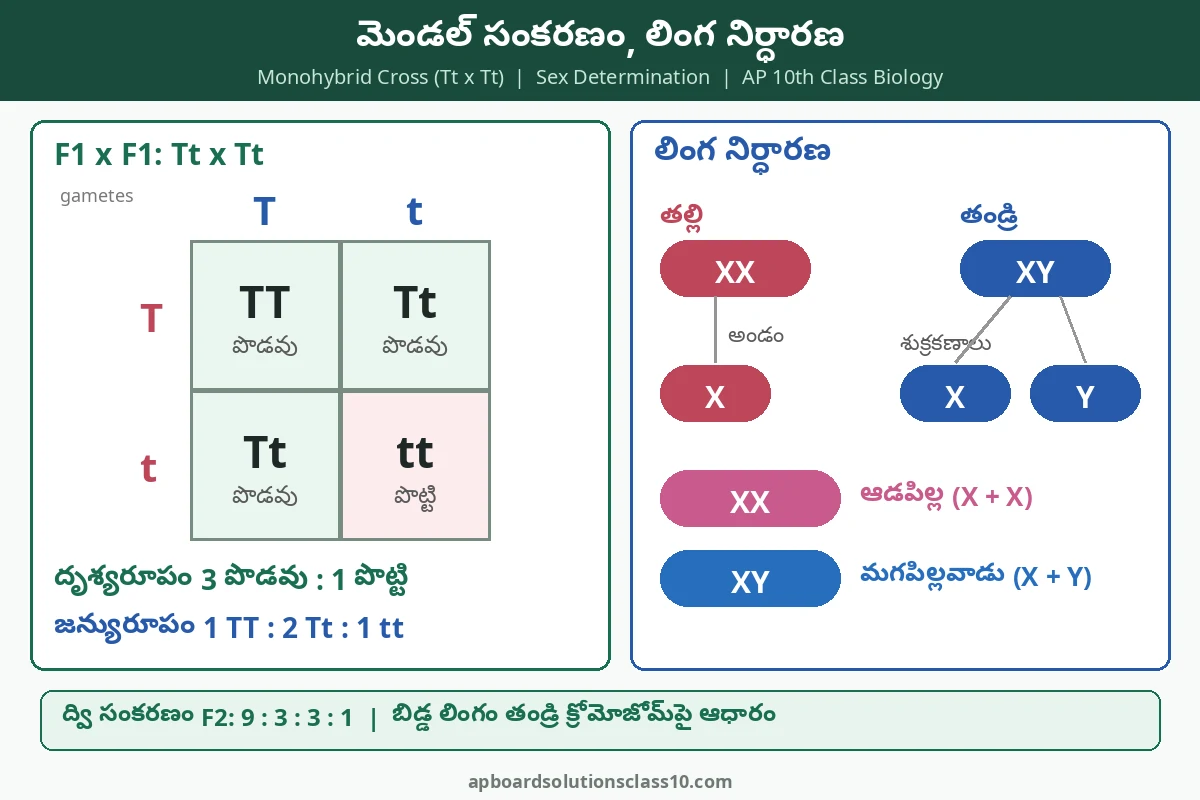
| అంశం | ఏక సంకర సంకరణం (Monohybrid) | ద్వి సంకర సంకరణం (Dihybrid) |
|---|---|---|
| జనకాలు | పొడవు (TT) x పొట్టి (tt) | గుండ్రని పసుపు (RRYY) x ముడతల ఆకుపచ్చ (rryy) |
| F1 తరం | అన్నీ పొడవు (Tt) | అన్నీ గుండ్రని పసుపు (RrYy) |
| F2 దృశ్యరూప నిష్పత్తి | 3 పొడవు : 1 పొట్టి | 9 : 3 : 3 : 1 |
| F2 జన్యురూప నిష్పత్తి | 1 TT : 2 Tt : 1 tt | — |
| తెలిసేది | బహిర్గత, అంతర్గత లక్షణాలు | లక్షణాలు స్వతంత్రంగా సంక్రమిస్తాయి |
లక్షణం ఎలా బయటపడుతుంది: జన్యువు ఒక ప్రోటీన్ (ఎంజైమ్) తయారీని నిర్ణయిస్తుంది. ఉదాహరణకు మొక్క ఎత్తుకు కావలసిన హార్మోన్ను తయారుచేసే ఎంజైమ్ సమర్థంగా పనిచేస్తే హార్మోన్ ఎక్కువై మొక్క పొడవుగా, లేకపోతే పొట్టిగా పెరుగుతుంది.
మానవుల్లో లింగ నిర్ధారణ
| తల్లి (XX) నుంచి | తండ్రి (XY) నుంచి | బిడ్డ |
|---|---|---|
| X | X | XX: ఆడపిల్ల |
| X | Y | XY: మగపిల్లవాడు |
తల్లి ఇచ్చేది ఎప్పుడూ X క్రోమోజోమే. బిడ్డ లింగం తండ్రి నుంచి వచ్చే క్రోమోజోమ్ (X లేదా Y) పై ఆధారపడుతుంది. ప్రతి కాన్పులో అవకాశం 50 : 50.
AP 10th Class Heredity Solutions — In-text Questions
పాఠం మధ్యలో వచ్చే ప్రశ్నలు. జవాబు చూడండి బటన్ నొక్కితే జవాబు కనిపిస్తుంది.
1. If a trait A exists in 10% of a population of an asexually reproducing species and a trait B exists in 60% of the same population, which trait is likely to have arisen earlier?
జవాబు చూడండి
తెలుగులో: ఎక్కువ శాతం జీవుల్లో ఉన్న లక్షణం (B) ముందే వచ్చి ఎక్కువ తరాల్లో వ్యాపించింది.
2. How does the creation of variations in a species promote survival?
జవాబు చూడండి
తెలుగులో: పరిస్థితులు మారినప్పుడు తగిన వైవిధ్యం ఉన్న జీవులు బతికి జాతిని కొనసాగిస్తాయి.
3. How do Mendel’s experiments show that traits may be dominant or recessive?
జవాబు చూడండి
తెలుగులో: F1 లో కనిపించిన పొడవు బహిర్గతం; F1 లో దాగి F2 లో కనిపించిన పొట్టి అంతర్గతం.
4. How do Mendel’s experiments show that traits are inherited independently?
జవాబు చూడండి
తెలుగులో: జనకాల్లో లేని కొత్త కలయికలు (గుండ్రని ఆకుపచ్చ, ముడతల పసుపు) రావడమే స్వతంత్ర సంక్రమణకు రుజువు.
5. A man with blood group A marries a woman with blood group O and their daughter has blood group O. Is this information enough to tell you which of the traits, blood group A or O, is dominant? Why or why not?
జవాబు చూడండి
తెలుగులో: ఒక్క బిడ్డ సమాచారంతో ఏది బహిర్గతమో చెప్పలేం; ఎక్కువ మంది పిల్లల సమాచారం కావాలి.
6. How is the sex of the child determined in human beings?
జవాబు చూడండి
తెలుగులో: బిడ్డ లింగాన్ని తండ్రి ఇచ్చే X లేదా Y క్రోమోజోమ్ నిర్ణయిస్తుంది.
AP 10th Class Heredity Solutions — Exercise Questions and Answers
పాఠం చివరి అభ్యాస ప్రశ్నలు. మొదటిది బహుళైచ్ఛిక ప్రశ్న.
1. A Mendelian experiment consisted of breeding tall pea plants bearing violet flowers with short pea plants bearing white flowers. The progeny all bore violet flowers, but almost half of them were short. This suggests that the genetic make-up of the tall parent can be depicted as (a) TTWW (b) TTww (c) TtWW (d) TtWw
జవాబు చూడండి
Reason: all the progeny have violet flowers, so the tall parent must be WW for flower colour. Almost half the progeny are short, so the tall parent must carry one gene for shortness: Tt.
తెలుగులో: అన్ని పువ్వులు ఊదా కాబట్టి WW; సగం పొట్టి కాబట్టి Tt.
2. A study found that children with light-coloured eyes are likely to have parents with light-coloured eyes. On this basis, can we say anything about whether the light eye colour trait is dominant or recessive? Why or why not?
జవాబు చూడండి
తెలుగులో: లక్షణం సంక్రమిస్తుందని మాత్రమే తెలుస్తుంది; బహిర్గతమో అంతర్గతమో చెప్పాలంటే వేర్వేరు రంగుల కళ్లు ఉన్న తల్లిదండ్రుల సంకరణ ఫలితాలు కావాలి.
3. Outline a project which aims to find the dominant coat colour in dogs.
జవాబు చూడండి
Step 1: Cross a pure black dog with a pure white dog and note the coat colour of all the puppies (F1).
Step 2: The colour seen in all F1 puppies is the dominant colour.
Step 3: Cross F1 dogs among themselves; in F2, the dominant and recessive colours should appear roughly in the ratio 3 : 1, which confirms the result.
తెలుగులో: F1 లో కనిపించే రంగు బహిర్గతం; F2 లో 3:1 నిష్పత్తి దాన్ని నిర్ధారిస్తుంది.
4. How is the equal genetic contribution of male and female parents ensured in the progeny?
జవాబు చూడండి
తెలుగులో: బీజకణాల్లో సగం క్రోమోజోములే ఉంటాయి; ఫలదీకరణంలో తల్లి నుంచి సగం, తండ్రి నుంచి సగం కలుస్తాయి.
10th Class Heredity Important Questions
పాఠ్యపుస్తకం ప్రశ్నలు కాకుండా, పరీక్షల్లో తరచూ వచ్చే రూపంలో మేము తయారు చేసిన ప్రశ్నలు.
1 మార్కు ప్రశ్నలు
1. What is the F2 phenotypic ratio in Mendel’s monohybrid cross?
జవాబు చూడండి
2. What is the F2 phenotypic ratio in a dihybrid cross?
జవాబు చూడండి
3. Which sex chromosome decides that a child will be a boy?
జవాబు చూడండి
4. Which plant did Mendel use for his experiments?
జవాబు చూడండి
2 మార్కుల ప్రశ్నలు
1. Differentiate between dominant and recessive traits.
జవాబు చూడండి
తెలుగులో: బహిర్గతం ఒక్క జన్యువు ఉన్నా కనిపిస్తుంది; అంతర్గతం రెండు జన్యువులూ అంతర్గతమైతేనే కనిపిస్తుంది.
2. Differentiate between genotype and phenotype with an example.
జవాబు చూడండి
తెలుగులో: TT, Tt జన్యురూపాలు వేరైనా దృశ్యరూపం ఒకటే: పొడవు.
3. Why did Mendel choose pea plants for his experiments?
జవాబు చూడండి
తెలుగులో: స్పష్టమైన వ్యతిరేక లక్షణాలు, తక్కువ జీవితకాలం, ఎక్కువ విత్తనాలు.
4. “Only variations that give an advantage to an individual survive in a population.” Do you agree? Why?
జవాబు చూడండి
తెలుగులో: లాభం ఇచ్చే వైవిధ్యాలు ఎక్కువగా నిలుస్తాయి, కానీ లాభం, నష్టం లేని వైవిధ్యాలు కూడా కొనసాగవచ్చు.
4 మార్కుల ప్రశ్నలు
1. Explain Mendel’s monohybrid cross with a checker board (Punnett square).
జవాబు చూడండి
F1 self-pollinated: Tt x Tt. Gametes from each: T and t.
Checker board: TT, Tt, Tt, tt.
Phenotypic ratio: 3 tall : 1 short. Genotypic ratio: 1 TT : 2 Tt : 1 tt.
Conclusion: tall is dominant, short is recessive; each trait is controlled by a pair of genes that separate during gamete formation.
తెలుగులో: పై చార్ట్లోని 2 x 2 చెక్కర్ బోర్డు ఇదే. నిష్పత్తులు రెండూ (3:1, 1:2:1) తప్పనిసరిగా రాయాలి.
2. Explain Mendel’s dihybrid cross and the conclusion drawn from it.
జవాబు చూడండి
F1 self-pollinated; each F1 plant forms four kinds of gametes: RY, Ry, rY, ry.
F2: round yellow 9, round green 3, wrinkled yellow 3, wrinkled green 1 (ratio 9 : 3 : 3 : 1).
Conclusion: round and yellow are dominant; seed shape and seed colour are inherited independently (law of independent inheritance).
తెలుగులో: నాలుగు రకాల బీజకణాలు, 16 కలయికలు, 9:3:3:1 నిష్పత్తి.
3. Explain sex determination in human beings with a flow chart.
జవాబు చూడండి
Egg X + sperm X gives XX: girl. Egg X + sperm Y gives XY: boy.
So there is an equal (50%) chance of a boy or a girl in every pregnancy, and the sex of the child depends on the sperm from the father.
తెలుగులో: పై చార్ట్లోని లింగ నిర్ధారణ భాగం చిత్రంగా గీయాలి.
4. How do traits get expressed? Explain with the example of plant height.
జవాబు చూడండి
తెలుగులో: జన్యువు, ఎంజైమ్, హార్మోన్, ఎత్తు: ఈ క్రమం రాయాలి.
Heredity క్విజ్ — 10 ప్రశ్నలు
జవాబు చూసి, మీది సరైతేనే టిక్ పెట్టండి. కింది బార్లో 10 కి మీ స్కోర్ కనిపిస్తుంది.
1. Mendel used which plant for his experiments?
(A) rose (B) garden pea (C) maize (D) mango [1 మార్కు]
జవాబు చూడండి
2. F2 phenotypic ratio of a monohybrid cross is:
(A) 1 : 1 (B) 2 : 1 (C) 3 : 1 (D) 9 : 3 : 3 : 1 [1 మార్కు]
జవాబు చూడండి
3. F2 genotypic ratio of a monohybrid cross is:
(A) 1 : 2 : 1 (B) 3 : 1 (C) 1 : 1 (D) 9 : 3 : 3 : 1 [1 మార్కు]
జవాబు చూడండి
4. F2 phenotypic ratio of a dihybrid cross is:
(A) 3 : 1 (B) 1 : 2 : 1 (C) 9 : 3 : 3 : 1 (D) 1 : 1 : 1 : 1 [1 మార్కు]
జవాబు చూడండి
5. In a Tt plant, the trait that is expressed is:
(A) recessive (B) dominant (C) both equally (D) neither [1 మార్కు]
జవాబు చూడండి
6. Sex chromosomes of a human male are:
(A) XX (B) XY (C) YY (D) XO [1 మార్కు]
జవాబు చూడండి
7. The sex of a child is decided by the chromosome from the:
(A) mother (B) father (C) both (D) grandparents [1 మార్కు]
జవాబు చూడండి
8. Tall violet x short white gave all violet, half short. Tall parent is:
(A) TTWW (B) TTww (C) TtWW (D) TtWw [1 మార్కు]
జవాబు చూడండి
9. A germ cell has:
(A) two sets of chromosomes (B) one set of chromosomes (C) no chromosomes (D) four sets [1 మార్కు]
జవాబు చూడండి
10. Differences among individuals of a species are called:
(A) heredity (B) variations (C) traits (D) genes [1 మార్కు]
జవాబు చూడండి
ఈ పాఠంలో మార్కులు ఎక్కడ పోతాయి
- దృశ్యరూప నిష్పత్తి (3:1), జన్యురూప నిష్పత్తి (1:2:1) తారుమారు చేయడం.
- చెక్కర్ బోర్డులో బీజకణాలు (T, t) పైన, పక్కన రాయకుండా నేరుగా ఫలితాలు రాయడం.
- బిడ్డ లింగాన్ని తల్లి నిర్ణయిస్తుందని రాయడం. తల్లి ఎప్పుడూ X మాత్రమే ఇస్తుంది; నిర్ణయించేది తండ్రి నుంచి వచ్చే X లేదా Y.
- ద్వి సంకర సంకరణంలో F1 బీజకణాలు నాలుగు రకాలు (RY, Ry, rY, ry) అని రాయకపోవడం.
- పెద్ద అక్షరం (T) బహిర్గతం, చిన్న అక్షరం (t) అంతర్గతం అనే గుర్తులను కలిపేయడం.
తర్వాత ఏం చదవాలి
- AP 10th Class SA1 Biology Question Paper 2026-27 — ఈ పాఠం ఉన్న SA1 సాధన పేపర్
- AP 10th Class How do Organisms Reproduce Solutions — మూడో పాఠం జవాబులు
- AP 10th Class Control and Coordination Solutions — రెండో పాఠం జవాబులు
- AP 10th Class Life Processes Solutions — మొదటి పాఠం జవాబులు
- AP 10th Class FA2 Biology Question Paper — FA2 అసలు పేపర్ జవాబులు
- AP 10th Class Biology Blueprint 2027 — ఏ పాఠానికి ఎన్ని మార్కులు
FAQs
AP 10th Class Heredity పాఠం ఏ నెలలో చెబుతారు?
AP SCERT నెలవారీ సిలబస్ ప్రకారం అక్టోబర్లో. పదో తరగతి జీవశాస్త్రంలో ఇది నాలుగో పాఠం.
అనువంశికత అంటే ఏమిటి?
తల్లిదండ్రుల లక్షణాలు జన్యువుల ద్వారా పిల్లలకు సంక్రమించడం.
బహిర్గత, అంతర్గత లక్షణాల తేడా ఏమిటి?
బహిర్గత లక్షణం ఒక్క జన్యువు ఉన్నా కనిపిస్తుంది. అంతర్గత లక్షణం రెండు జన్యువులూ అంతర్గతమైతేనే కనిపిస్తుంది.
మెండల్ ఏక సంకర సంకరణ నిష్పత్తి ఎంత?
F2 లో దృశ్యరూప నిష్పత్తి 3 : 1, జన్యురూప నిష్పత్తి 1 : 2 : 1.
ద్వి సంకర సంకరణ నిష్పత్తి ఎంత?
F2 లో 9 : 3 : 3 : 1.
బిడ్డ లింగాన్ని ఎవరు నిర్ణయిస్తారు?
తండ్రి నుంచి వచ్చే క్రోమోజోమ్. X వస్తే ఆడపిల్ల (XX), Y వస్తే మగపిల్లవాడు (XY).
మెండల్ బఠాణి మొక్కనే ఎందుకు ఎంచుకున్నాడు?
స్పష్టమైన వ్యతిరేక లక్షణాలు, తక్కువ జీవితకాలం, ఎక్కువ విత్తనాలు, సులువుగా సంకరణం చేయవచ్చు.
ఈ పాఠంలో ఏ చిత్రాలు ముఖ్యం?
ఏక సంకర సంకరణం చెక్కర్ బోర్డు, ద్వి సంకర సంకరణం, లింగ నిర్ధారణ చిత్రం.
SA1 లో ఈ పాఠం వస్తుందా?
అవును, అనువంశికత SA1 సిలబస్లో ఉంది. AP 10th Class SA1 Biology Question Paper లో సాధన చేయండి.
తర్వాతి పాఠం జవాబులు ఎప్పుడు?
తర్వాత Our Environment (మన పర్యావరణం) పాఠం జవాబుల పేజీ వస్తుంది.
Official Sources
పాఠాల క్రమం, నెలవారీ ప్రణాళిక: AP SCERT 2026-27 నెలవారీ సిలబస్, పాఠశాల విద్యాశాఖ ఆంధ్రప్రదేశ్. పాఠ్యపుస్తకాలు పాఠశాల విద్యాశాఖ సైట్లో లభిస్తాయి. జవాబులు మా సొంత మాటల్లో రాశాం.