AP 10th Class Maths Arithmetic Progressions Solutions — అధ్యాయం 5 (అంకశ్రేఢులు) లోని Exercise 5.1, 5.2, 5.3 లోని అన్ని లెక్కలకు, ఐచ్ఛిక Exercise 5.4 కి కలిపి 53 జవాబు బటన్లతో దశలవారీ సాధనలు. అంకశ్రేఢి అవునో కాదో చెప్పడం, n వ పదం, పదాల సంఖ్య, మొదటి n పదాల మొత్తం, మాటల లెక్కలు — ప్రతిదీ పరీక్షలో రాసే వరుసలో. ప్రశ్నలు AP SCERT పుస్తకంలో ఉన్నట్టే ఇంగ్లీష్లో, వివరణ తెలుగులో.
SA1 గణితం మిగతా జవాబులు, పరీక్ష రోజు కీ వచ్చిన వెంటనే తెలియాలంటే WhatsApp గ్రూప్లో చేరండి
ఈ పేజీలో: అధ్యాయంలో ఏముంది | ముఖ్య సూత్రాలు | Exercise 5.1 | Exercise 5.2 | Exercise 5.3 | Exercise 5.4 | మార్కులు పోయే చోట్లు | FAQs
AP 10th Class Maths Arithmetic Progressions Solutions — ఈ అధ్యాయంలో ఏముంది
| ఎక్సర్సైజ్ | అంశం | ప్రశ్నలు |
|---|---|---|
| Exercise 5.1 | అంకశ్రేఢి అవునో కాదో, a, d కనుక్కోవడం, తర్వాతి పదాలు | 4 |
| Exercise 5.2 | n వ పదం an = a + (n − 1)d, పదాల సంఖ్య, మాటల లెక్కలు | 20 |
| Exercise 5.3 | మొదటి n పదాల మొత్తం, మాటల లెక్కలు | 20 |
| Exercise 5.4 (ఐచ్ఛికం) | పరీక్ష దృష్టితో కాదని పుస్తకమే చెప్పింది; అభ్యాసం కోసం | 5 |
SA1 కి ఎందుకు ముఖ్యం: అంకశ్రేఢులు 10వ తరగతి SA1 గణితం సిలబస్లో ఉంది (AP SA1 Syllabus 2026-27 చూడండి), FA2 లో కూడా వచ్చింది. ఇక్కడి ప్రశ్నల పాఠం AP SCERT 10వ తరగతి గణితం Semester 1 పాఠ్యపుస్తకం (పేజీలు 98 నుంచి 145) నుంచే తీసుకున్నాం; ప్రతి జవాబునూ పుస్తకం చివరి ANSWERS/HINTS పేజీతో సరిచూశాం.
Arithmetic Progressions ముఖ్య సూత్రాలు
- అంకశ్రేఢి: మొదటి పదం తప్ప ప్రతి పదం, ముందు పదానికి ఒక స్థిర సంఖ్య d కలిపితే వస్తుంది. సాధారణ రూపం a, a + d, a + 2d, a + 3d, …
- సామాన్య భేదం: d = ak+1 − ak. d ధనం, ఋణం లేదా సున్న కావచ్చు. అంకశ్రేఢి అని చెప్పాలంటే కనీసం మూడు వరుస భేదాలు సరిచూడాలి.
- n వ పదం: an = a + (n − 1)d. చివరి పదాన్ని l తో రాస్తారు.
- మొదటి n పదాల మొత్తం: Sn = n⁄2[2a + (n − 1)d], లేదా చివరి పదం తెలిస్తే Sn = n⁄2(a + l).
- మొత్తం నుంచి పదం: an = Sn − Sn−1. మొదటి n సహజ సంఖ్యల మొత్తం n(n + 1)⁄2.
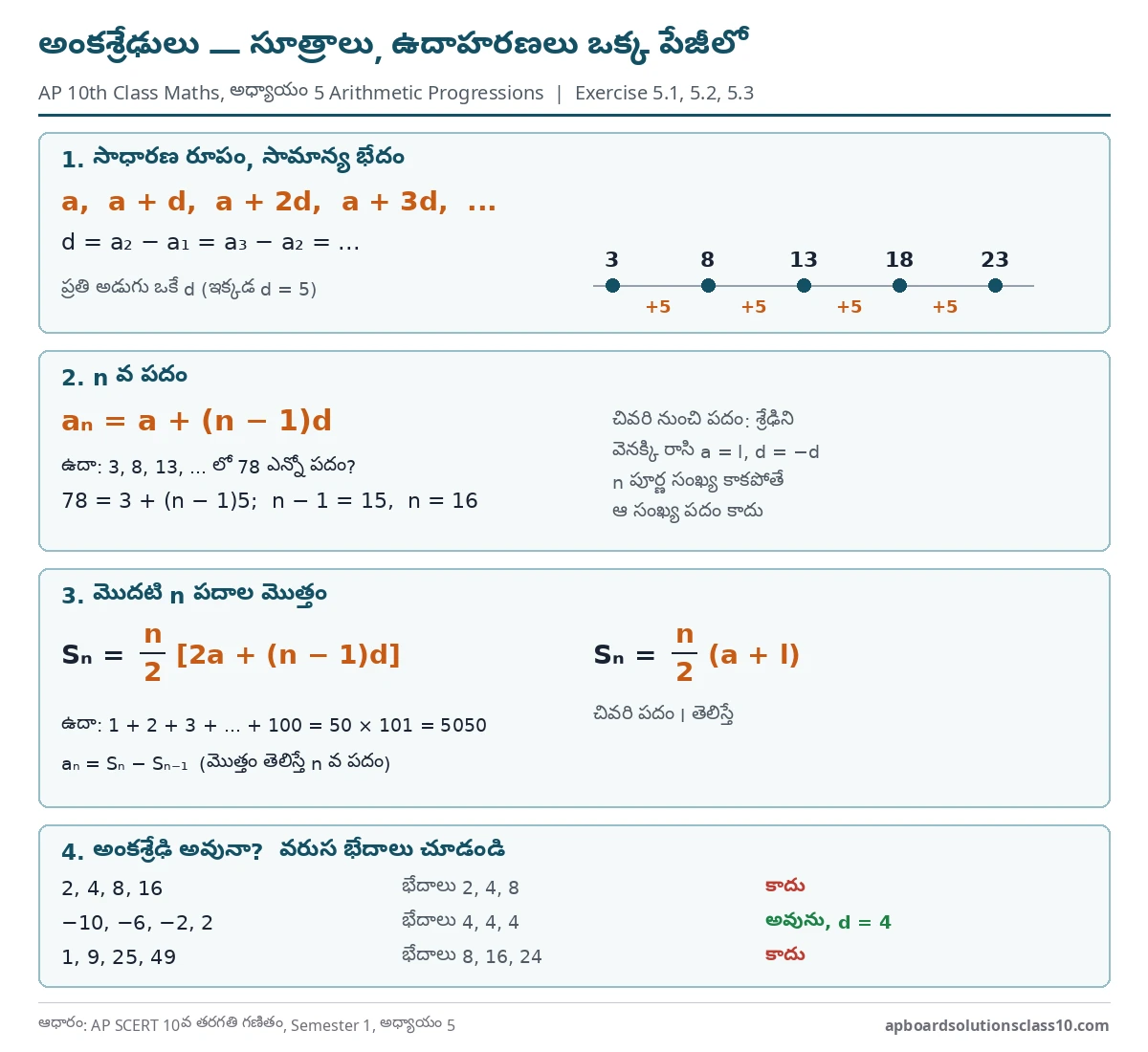
అంకశ్రేఢి సాధారణ రూపం, n వ పదం, మొత్తం సూత్రాలు, పుస్తకంలోని లెక్కలతో ఉదాహరణలు ఒకే చార్ట్లో.
AP 10th Class Maths Arithmetic Progressions Exercise 5.1 Solutions (Identifying APs)
అంకశ్రేఢి అవునో కాదో చెప్పేటప్పుడు రెండు మూడు వరుస భేదాలు లెక్కించి రాయండి; ఒక్క భేదం చూసి నిర్ణయించవద్దు. √ ఉన్న పదాలను ముందు సరళీకరించండి.
1. In which of the following situations, does the list of numbers involved make an arithmetic progression, and why?
(i) The taxi fare after each km when the fare is ₹ 15 for the first km and ₹ 8 for each additional km.
(ii) The amount of air present in a cylinder when a vacuum pump removes 1⁄4 of the air remaining in the cylinder at a time.
జవాబు చూడండి
(i) 1 కి.మీ కి ₹ 15, 2 కి.మీ కి 15 + 8 = ₹ 23, 3 కి.మీ కి ₹ 31, … జాబితా: 15, 23, 31, 39, …
ప్రతి పదం ముందు పదానికి 8 కలిపితే వస్తోంది (d = 8). అంకశ్రేఢి అవుతుంది
(ii) గాలి V అనుకుందాం. ప్రతిసారీ 1⁄4 వంతు పోతే 3⁄4 వంతు మిగులుతుంది: V, 3⁄4V, (3⁄4)2V, …
భేదాలు −V⁄4, −3V⁄16 వేర్వేరు. ప్రతిసారీ 3⁄4 తో గుణిస్తున్నాం, కలపడం లేదు. అంకశ్రేఢి కాదు
1. (iii) The cost of digging a well after every metre of digging, when it costs ₹ 150 for the first metre and rises by ₹ 50 for each subsequent metre.
(iv) The amount of money in the account every year, when ₹ 10000 is deposited at compound interest at 8 % per annum.
జవాబు చూడండి
భేదం ప్రతిసారీ 50 (d = 50). అంకశ్రేఢి అవుతుంది
(iv) చక్రవడ్డీలో ప్రతి సంవత్సరం మొత్తం 1.08 తో గుణించబడుతుంది: 10000(1.08), 10000(1.08)2, 10000(1.08)3, … అంటే 10800, 11664, 12597.12, …
భేదాలు 864, 933.12 వేర్వేరు. అంకశ్రేఢి కాదు (బారువడ్డీ అయితే అంకశ్రేఢి అవుతుంది, Example 9 లో చూశాం).
2. Write first four terms of the AP, when the first term a and the common difference d are given as follows:
(i) a = 10, d = 10 (ii) a = −2, d = 0 (iii) a = 4, d = − 3 (iv) a = − 1, d = 1⁄2 (v) a = − 1.25, d = − 0.25
జవాబు చూడండి
(i) 10, 20, 30, 40
(ii) d = 0 కాబట్టి అన్ని పదాలూ ఒకటే: −2, −2, −2, −2
(iii) 4, 4 − 3, 1 − 3, −2 − 3: 4, 1, −2, −5
(iv) −1, −1⁄2, 0, 1⁄2
(v) −1.25, −1.50, −1.75, −2.00
3. For the following APs, write the first term and the common difference:
(i) 3, 1, − 1, − 3, . . . (ii) − 5, − 1, 3, 7, . . .
(iii) 1⁄3, 5⁄3, 9⁄3, 13⁄3, . . . (iv) 0.6, 1.7, 2.8, 3.9, . . .
జవాబు చూడండి
(i) a = 3, d = 1 − 3 = −2
(ii) a = −5, d = −1 − (−5) = 4
(iii) a = 1⁄3, d = 5⁄3 − 1⁄3 = 4⁄3
(iv) a = 0.6, d = 1.7 − 0.6 = 1.1
4. Which of the following are APs ? If they form an AP, find the common difference d and write three more terms.
(i) 2, 4, 8, 16, . . . (ii) 2, 5⁄2, 3, 7⁄2, . . . (iii) − 1.2, − 3.2, − 5.2, − 7.2, . . .
(iv) − 10, − 6, − 2, 2, . . . (v) 3, 3 + √2, 3 + 2√2, 3 + 3√2, . . .
జవాబు చూడండి
(ii) ప్రతి భేదం 1⁄2. అంకశ్రేఢి, d = 1⁄2; తర్వాతి పదాలు 4, 9⁄2, 5
(iii) ప్రతి భేదం −2. అంకశ్రేఢి, d = −2; తర్వాతి పదాలు −9.2, −11.2, −13.2
(iv) ప్రతి భేదం 4. అంకశ్రేఢి, d = 4; తర్వాతి పదాలు 6, 10, 14
(v) ప్రతి భేదం √2. అంకశ్రేఢి, d = √2; తర్వాతి పదాలు 3 + 4√2, 3 + 5√2, 3 + 6√2
4. (vi) 0.2, 0.22, 0.222, 0.2222, . . . (vii) 0, − 4, − 8, −12, . . .
(viii) −1⁄2, −1⁄2, −1⁄2, −1⁄2, . . . (ix) 1, 3, 9, 27, . . . (x) a, 2a, 3a, 4a, . . .
జవాబు చూడండి
(vii) ప్రతి భేదం −4. అంకశ్రేఢి, d = −4; తర్వాతి పదాలు −16, −20, −24
(viii) ప్రతి భేదం 0. అంకశ్రేఢి, d = 0; తర్వాతి పదాలు −1⁄2, −1⁄2, −1⁄2
(ix) భేదాలు 2, 6 వేర్వేరు (ప్రతిసారీ 3 తో గుణిస్తున్నాం). అంకశ్రేఢి కాదు
(x) ప్రతి భేదం a. అంకశ్రేఢి, d = a; తర్వాతి పదాలు 5a, 6a, 7a
4. (xi) a, a2, a3, a4, . . . (xii) √2, √8, √18, √32, . . . (xiii) √3, √6, √9, √12, . . .
(xiv) 12, 32, 52, 72, . . . (xv) 12, 52, 72, 73, . . .
జవాబు చూడండి
(xii) √8 = 2√2, √18 = 3√2, √32 = 4√2. జాబితా √2, 2√2, 3√2, 4√2. అంకశ్రేఢి, d = √2; తర్వాతి పదాలు 5√2, 6√2, 7√2, అంటే √50, √72, √98
(xiii) √6 − √3 = √3(√2 − 1), √9 − √6 = 3 − √6 వేర్వేరు. అంకశ్రేఢి కాదు
(xiv) 1, 9, 25, 49. భేదాలు 8, 16, 24 వేర్వేరు. అంకశ్రేఢి కాదు
(xv) 1, 25, 49, 73. ప్రతి భేదం 24. అంకశ్రేఢి, d = 24; తర్వాతి పదాలు 97, 121, 145
AP 10th Class Maths Arithmetic Progressions Exercise 5.2 Solutions (nth Term of an AP)
ప్రతి లెక్కలో ముందు a, d, n లలో ఏవి తెలుసో రాసి, తర్వాత an = a + (n − 1)d లో ప్రతిక్షేపించండి. n పూర్ణ సంఖ్య కాకపోతే ఆ సంఖ్య పదం కాదు.
1. Fill in the blanks in the following table, given that a is the first term, d the common difference and an the nth term of the AP:
(i) a = 7, d = 3, n = 8, an = ? (ii) a = − 18, d = ?, n = 10, an = 0 (iii) a = ?, d = − 3, n = 18, an = − 5
(iv) a = − 18.9, d = 2.5, n = ?, an = 3.6 (v) a = 3.5, d = 0, n = 105, an = ?
జవాబు చూడండి
(i) a8 = 7 + 7 × 3 = 28
(ii) 0 = −18 + 9d, కాబట్టి 9d = 18, d = 2
(iii) −5 = a + 17(−3) = a − 51, కాబట్టి a = 46
(iv) 3.6 = −18.9 + (n − 1)2.5, (n − 1)2.5 = 22.5, n − 1 = 9, n = 10
(v) d = 0 కాబట్టి అన్ని పదాలూ 3.5: a105 = 3.5
2. Choose the correct choice in the following and justify :
(i) 30th term of the AP: 10, 7, 4, . . . , is (A) 97 (B) 77 (C) −77 (D) − 87
(ii) 11th term of the AP: − 3, −1⁄2, 2, . . ., is (A) 28 (B) 22 (C) −38 (D) − 481⁄2
జవాబు చూడండి
(ii) a = −3, d = −1⁄2 − (−3) = 5⁄2. a11 = −3 + 10 × 5⁄2 = −3 + 25 = 22. జవాబు (B) 22
3. In the following APs, find the missing terms in the boxes :
(i) 2, [ ], 26 (ii) [ ], 13, [ ], 3 (iii) 5, [ ], [ ], 9½
(iv) − 4, [ ], [ ], [ ], [ ], 6 (v) [ ], 38, [ ], [ ], [ ], − 22
జవాబు చూడండి
(ii) a2 = 13, a4 = 3. a4 − a2 = 2d = −10, d = −5. ఖాళీలు: 18, 8 (జాబితా 18, 13, 8, 3)
(iii) a4 = 5 + 3d = 9½, 3d = 4½, d = 1½. ఖాళీలు: 6½, 8
(iv) a6 = −4 + 5d = 6, d = 2. ఖాళీలు: −2, 0, 2, 4
(v) a2 = 38, a6 = −22. 4d = −60, d = −15. a = 38 + 15 = 53. ఖాళీలు: 53, 23, 8, −7
4. Which term of the AP : 3, 8, 13, 18, . . . ,is 78?
జవాబు చూడండి
78 = 3 + (n − 1)5, (n − 1)5 = 75, n − 1 = 15, n = 16.
78 అనేది 16వ పదం.
5. Find the number of terms in each of the following APs :
(i) 7, 13, 19, . . . , 205 (ii) 18, 15½, 13, . . . , − 47
జవాబు చూడండి
(ii) a = 18, d = 15½ − 18 = −2½, l = −47.
−47 = 18 + (n − 1)(−5⁄2), (n − 1)5⁄2 = 65, n − 1 = 26, n = 27
6. Check whether − 150 is a term of the AP : 11, 8, 5, 2 . . .
జవాబు చూడండి
−150 = 11 + (n − 1)(−3), 3(n − 1) = 161, n − 1 = 161⁄3.
n పూర్ణ సంఖ్య కాదు. −150 ఈ అంకశ్రేఢిలో పదం కాదు.
7. Find the 31st term of an AP whose 11th term is 38 and the 16th term is 73.
జవాబు చూడండి
తీసివేస్తే 5d = 35, d = 7. a = 38 − 70 = −32.
a31 = a + 30d = −32 + 210 = 178
8. An AP consists of 50 terms of which 3rd term is 12 and the last term is 106. Find the 29th term.
జవాబు చూడండి
తీసివేస్తే 47d = 94, d = 2. a = 12 − 4 = 8.
a29 = 8 + 28 × 2 = 64
9. If the 3rd and the 9th terms of an AP are 4 and − 8 respectively, which term of this AP is zero?
జవాబు చూడండి
an = 0: 8 + (n − 1)(−2) = 0, n − 1 = 4, n = 5.
5వ పదం సున్న.
10. The 17th term of an AP exceeds its 10th term by 7. Find the common difference.
జవాబు చూడండి
7d = 7, d = 1
11. Which term of the AP : 3, 15, 27, 39, . . . will be 132 more than its 54th term?
జవాబు చూడండి
కావలసిన పదం = 639 + 132 = 771.
771 = 3 + (n − 1)12, n − 1 = 64, n = 65. 65వ పదం
చిన్న దారి: 132 = 11 × 12, కాబట్టి 54 + 11 = 65వ పదం.
12. Two APs have the same common difference. The difference between their 100th terms is 100, what is the difference between their 1000th terms?
జవాబు చూడండి
100వ పదాల భేదం: (a + 99d) − (b + 99d) = a − b = 100.
1000వ పదాల భేదం: (a + 999d) − (b + 999d) = a − b = 100
d ఒకటే కాబట్టి ఏ స్థానంలోనైనా భేదం మొదటి పదాల భేదమే.
13. How many three-digit numbers are divisible by 7?
జవాబు చూడండి
అంకశ్రేఢి 105, 112, …, 994; d = 7.
994 = 105 + (n − 1)7, n − 1 = 127, n = 128. 128 సంఖ్యలు
14. How many multiples of 4 lie between 10 and 250?
జవాబు చూడండి
248 = 12 + (n − 1)4, n − 1 = 59, n = 60. 60 గుణిజాలు
15. For what value of n, are the nth terms of two APs: 63, 65, 67, . . . and 3, 10, 17, . . . equal?
జవాబు చూడండి
సమానం చేస్తే 60 = 5(n − 1), n − 1 = 12, n = 13
సరిచూడటం: రెండింట్లోనూ 13వ పదం 87.
16. Determine the AP whose third term is 16 and the 7th term exceeds the 5th term by 12.
జవాబు చూడండి
a3 = a + 12 = 16, a = 4.
అంకశ్రేఢి: 4, 10, 16, 22, …
17. Find the 20th term from the last term of the AP : 3, 8, 13, . . ., 253.
జవాబు చూడండి
చివరి నుంచి 20వ పదం = 253 + 19(−5) = 253 − 95 = 158
సరిచూడటం: మొత్తం 51 పదాలు; చివరి నుంచి 20వది మొదటి నుంచి 32వది, a32 = 3 + 31 × 5 = 158.
18. The sum of the 4th and 8th terms of an AP is 24 and the sum of the 6th and 10th terms is 44. Find the first three terms of the AP.
జవాబు చూడండి
(a + 5d) + (a + 9d) = 44, అంటే 2a + 14d = 44.
తీసివేస్తే 4d = 20, d = 5; 2a = 24 − 50, a = −13.
మొదటి మూడు పదాలు: −13, −8, −3
19. Subba Rao started work in 1995 at an annual salary of ₹ 5000 and received an increment of ₹ 200 each year. In which year did his income reach ₹ 7000?
జవాబు చూడండి
7000 = 5000 + (n − 1)200, n − 1 = 10, n = 11.
11వ సంవత్సరంలో, అంటే 1995 నుంచి లెక్కిస్తే 2005 లో ₹ 7000 అవుతుంది.
20. Ramkali saved ₹ 5 in the first week of a year and then increased her weekly savings by ₹ 1.75. If in the nth week, her weekly savings become ₹ 20.75, find n.
జవాబు చూడండి
20.75 = 5 + (n − 1)1.75, (n − 1)1.75 = 15.75, n − 1 = 9, n = 10
AP 10th Class Maths Arithmetic Progressions Exercise 5.3 Solutions (Sum of First n Terms)
చివరి పదం l తెలిస్తే Sn = n⁄2(a + l) వేగంగా పనిచేస్తుంది; లేకపోతే Sn = n⁄2[2a + (n − 1)d]. n కి వర్గ సమీకరణం వస్తే, ఋణ లేదా భిన్న విలువను కారణంతో వదిలేయండి.
1. Find the sum of the following APs:
(i) 2, 7, 12, . . ., to 10 terms. (ii) −37, −33, −29, . . ., to 12 terms.
(iii) 0.6, 1.7, 2.8, . . ., to 100 terms. (iv) 1⁄15, 1⁄12, 1⁄10, . . ., to 11 terms.
జవాబు చూడండి
(ii) a = −37, d = 4, n = 12: S12 = 6[−74 + 44] = −180
(iii) a = 0.6, d = 1.1, n = 100: S100 = 50[1.2 + 108.9] = 50 × 110.1 = 5505
(iv) a = 1⁄15, d = 1⁄12 − 1⁄15 = 1⁄60, n = 11:
S11 = 11⁄2[2⁄15 + 10⁄60] = 11⁄2 × 9⁄30 = 33⁄20
2. Find the sums given below :
(i) 7 + 10½ + 14 + . . . + 84 (ii) 34 + 32 + 30 + . . . + 10 (iii) −5 + (−8) + (−11) + . . . + (−230)
జవాబు చూడండి
(i) a = 7, d = 3½, l = 84: 84 = 7 + (n − 1)7⁄2, n = 23. S = 23⁄2(7 + 84) = 2093⁄2 = 1046½
(ii) a = 34, d = −2, l = 10: n = 13. S = 13⁄2(34 + 10) = 286
(iii) a = −5, d = −3, l = −230: −230 = −5 + (n − 1)(−3), n = 76. S = 38(−5 − 230) = −8930
3. In an AP:
(i) given a = 5, d = 3, an = 50, find n and Sn. (ii) given a = 7, a13 = 35, find d and S13.
(iii) given a12 = 37, d = 3, find a and S12. (iv) given a3 = 15, S10 = 125, find d and a10.
(v) given d = 5, S9 = 75, find a and a9.
జవాబు చూడండి
(ii) 35 = 7 + 12d, d = 7⁄3. S13 = 13⁄2(7 + 35) = 273. d = 7⁄3, S13 = 273
(iii) 37 = a + 33, a = 4. S12 = 6(4 + 37) = 246. a = 4, S12 = 246
(iv) a + 2d = 15; S10 = 5(2a + 9d) = 125, అంటే 2a + 9d = 25. 2a + 4d = 30 తీసివేస్తే 5d = −5, d = −1, a = 17. a10 = 17 − 9 = 8. d = −1, a10 = 8
(v) S9 = 9⁄2(2a + 40) = 75, 2a + 40 = 50⁄3, a = −35⁄3. a9 = −35⁄3 + 40 = 85⁄3. a = −35⁄3, a9 = 85⁄3
3. (vi) given a = 2, d = 8, Sn = 90, find n and an. (vii) given a = 8, an = 62, Sn = 210, find n and d.
(viii) given an = 4, d = 2, Sn = −14, find n and a. (ix) given a = 3, n = 8, S = 192, find d.
(x) given l = 28, S = 144, and there are total 9 terms. Find a.
జవాబు చూడండి
(vii) 210 = n⁄2(8 + 62), n = 6. 62 = 8 + 5d, d = 54⁄5. n = 6, d = 54⁄5
(viii) 4 = a + 2(n − 1), a = 6 − 2n. Sn = n⁄2(a + 4) = n(5 − n) = −14, n2 − 5n − 14 = 0, n = 7. a = 6 − 14 = −8. n = 7, a = −8
(ix) 192 = 4(6 + 7d), 6 + 7d = 48, d = 6
(x) 144 = 9⁄2(a + 28), a + 28 = 32, a = 4
4. How many terms of the AP : 9, 17, 25, . . . must be taken to give a sum of 636?
జవాబు చూడండి
4n2 + 5n − 636 = 0, (n − 12)(4n + 53) = 0.
n = 12 లేదా −53⁄4. పదాల సంఖ్య ఋణం కాదు. 12 పదాలు
5. The first term of an AP is 5, the last term is 45 and the sum is 400. Find the number of terms and the common difference.
జవాబు చూడండి
45 = 5 + 15d, d = 8⁄3
6. The first and the last terms of an AP are 17 and 350 respectively. If the common difference is 9, how many terms are there and what is their sum?
జవాబు చూడండి
S = 19(17 + 350) = 6973
7. Find the sum of first 22 terms of an AP in which d = 7 and 22nd term is 149.
జవాబు చూడండి
S22 = 11(2 + 149) = 1661
8. Find the sum of first 51 terms of an AP whose second and third terms are 14 and 18 respectively.
జవాబు చూడండి
S51 = 51⁄2[20 + 50 × 4] = 51⁄2 × 220 = 5610
9. If the sum of first 7 terms of an AP is 49 and that of 17 terms is 289, find the sum of first n terms.
జవాబు చూడండి
S17 = 17⁄2(2a + 16d) = 289, అంటే a + 8d = 17.
తీసివేస్తే 5d = 10, d = 2, a = 1.
Sn = n⁄2[2 + 2(n − 1)] = n2
10. Show that a1, a2, . . ., an, . . . form an AP where an is defined as below :
(i) an = 3 + 4n (ii) an = 9 − 5n
Also find the sum of the first 15 terms in each case.
జవాబు చూడండి
S15 = 15⁄2(a1 + a15) = 15⁄2(7 + 63) = 525
(ii) an+1 − an = −5, స్థిరం. కాబట్టి అంకశ్రేఢి; a = 4, d = −5.
S15 = 15⁄2(4 + (−66)) = −465
11. If the sum of the first n terms of an AP is 4n − n2, what is the first term (that is S1)? What is the sum of first two terms? What is the second term? Similarly, find the 3rd, the 10th and the nth terms.
జవాబు చూడండి
S2 = 8 − 4 = 4; a2 = S2 − S1 = 1
S3 = 12 − 9 = 3; a3 = S3 − S2 = −1
a10 = S10 − S9 = (40 − 100) − (36 − 81) = −60 + 45 = −15
an = Sn − Sn−1 = (4n − n2) − [4(n − 1) − (n − 1)2] = 5 − 2n
12. Find the sum of the first 40 positive integers divisible by 6.
జవాబు చూడండి
S40 = 20(6 + 240) = 4920
13. Find the sum of the first 15 multiples of 8.
జవాబు చూడండి
S15 = 15⁄2(8 + 120) = 960
14. Find the sum of the odd numbers between 0 and 50.
జవాబు చూడండి
S = 25⁄2(1 + 49) = 625
15. A contract on construction job specifies a penalty for delay of completion beyond a certain date as follows: ₹ 200 for the first day, ₹ 250 for the second day, ₹ 300 for the third day, etc., the penalty for each succeeding day being ₹ 50 more than for the preceding day. How much money the contractor has to pay as penalty, if he has delayed the work by 30 days?
జవాబు చూడండి
S30 = 15[400 + 29 × 50] = 15 × 1850 = ₹ 27750
16. A sum of ₹ 700 is to be used to give seven cash prizes to students of a school for their overall academic performance. If each prize is ₹ 20 less than its preceding prize, find the value of each of the prizes.
జవాబు చూడండి
S7 = 7⁄2[2a − 120] = 700, 2a − 120 = 200, a = 160.
బహుమతులు: ₹ 160, 140, 120, 100, 80, 60, 40
17. In a school, students thought of planting trees in and around the school to reduce air pollution. It was decided that the number of trees, that each section of each class will plant, will be the same as the class, in which they are studying, e.g., a section of Class I will plant 1 tree, a section of Class II will plant 2 trees and so on till Class XII. There are three sections of each class. How many trees will be planted by the students?
జవాబు చూడండి
a = 3, d = 3, n = 12. S = 6(3 + 36) = 234 మొక్కలు
18. A spiral is made up of successive semicircles, with centres alternately at A and B, starting with centre at A, of radii 0.5 cm, 1.0 cm, 1.5 cm, 2.0 cm, . . . as shown in Fig. 5.4. What is the total length of such a spiral made up of thirteen consecutive semicircles? (Take π = 22⁄7)
జవాబు చూడండి
వ్యాసార్ధాల మొత్తం = 13⁄2(0.5 + 6.5) = 45.5.
పొడవు = 22⁄7 × 45.5 = 143 సెం.మీ
19. 200 logs are stacked in the following manner: 20 logs in the bottom row, 19 in the next row, 18 in the row next to it and so on (see Fig. 5.5). In how many rows are the 200 logs placed and how many logs are in the top row?
జవాబు చూడండి
(n − 16)(n − 25) = 0, n = 16 లేదా 25. n = 25 అయితే a25 = 20 − 24 = −4 దుంగలు, అసాధ్యం.
16 వరుసలు; పై వరుసలో a16 = 20 − 15 = 5 దుంగలు
20. In a potato race, a bucket is placed at the starting point, which is 5 m from the first potato, and the other potatoes are placed 3 m apart in a straight line. There are ten potatoes in the line (see Fig. 5.6). A competitor starts from the bucket, picks up the nearest potato, runs back with it, drops it in the bucket, runs back to pick up the next potato, runs to the bucket to drop it in, and she continues in the same way until all the potatoes are in the bucket. What is the total distance the competitor has to run?
జవాబు చూడండి
దూరాలు: 10, 16, 22, …; a = 10, d = 6, n = 10.
S = 5[20 + 54] = 370 మీ
AP 10th Class Maths Arithmetic Progressions Exercise 5.4 Solutions (Optional)
పుస్తకం ఈ ఎక్సర్సైజ్ను “Not from the examination point of view” అని గుర్తించింది. ఆలోచన పెంచుకోవడానికి మాత్రమే.
1. Which term of the AP : 121, 117, 113, . . ., is its first negative term?
జవాబు చూడండి
కనీస పూర్ణ సంఖ్య n = 32: a32 = 121 − 124 = −3. 32వ పదం
2. The sum of the third and the seventh terms of an AP is 6 and their product is 8. Find the sum of first sixteen terms of the AP.
జవాబు చూడండి
(a + 2d)(a + 6d) = (3 − 2d)(3 + 2d) = 9 − 4d2 = 8, d = ±1⁄2.
d = 1⁄2: a = 1, S16 = 8(2 + 7.5) = 76
d = −1⁄2: a = 5, S16 = 8(10 − 7.5) = 20
3. A ladder has rungs 25 cm apart. The rungs decrease uniformly in length from 45 cm at the bottom to 25 cm at the top. If the top and the bottom rungs are 2½ m apart, what is the length of the wood required for the rungs?
జవాబు చూడండి
పొడవులు 45 నుంచి 25 వరకు అంకశ్రేఢి. S = 11⁄2(45 + 25) = 385 సెం.మీ
4. The houses of a row are numbered consecutively from 1 to 49. Show that there is a value of x such that the sum of the numbers of the houses preceding the house numbered x is equal to the sum of the numbers of the houses following it. Find this value of x.
జవాబు చూడండి
సమానం చేస్తే x2 = 1225, x = 35
సరిచూడటం: 1 నుంచి 34 మొత్తం 595, 36 నుంచి 49 మొత్తం 595.
5. A small terrace at a football ground comprises of 15 steps each of which is 50 m long and built of solid concrete. Each step has a rise of 1⁄4 m and a tread of 1⁄2 m. Calculate the total volume of concrete required to build the terrace.
జవాబు చూడండి
ఘనపరిమాణాలు 25⁄4, 50⁄4, … అంకశ్రేఢి, n = 15.
S = 25⁄4(1 + 2 + … + 15) = 25⁄4 × 120 = 750 మీ3
Arithmetic Progressions లో మార్కులు ఎక్కడ పోతాయి
- d గుర్తు: 10, 7, 4, … లో d = 7 − 10 = −3, 3 కాదు. ఎప్పుడూ తర్వాతి పదం నుంచి ముందు పదం తీసివేయండి.
- n − 1 బదులు n: 30వ పదానికి a + 29d, a + 30d కాదు.
- “మధ్యలో” అనే మాట: 10, 250 మధ్య 4 గుణిజాలు అంటే 12 నుంచి 248 వరకు; 10, 250 లెక్కలోకి రావు.
- రెండు n విలువలు: దుంగల లెక్కలో n = 16, 25 రెండూ వస్తాయి; n = 25 అయితే పై వరుసలో −4 దుంగలు, కాబట్టి 16 మాత్రమే.
- చివరి నుంచి పదం: శ్రేఢిని వెనక్కి రాసి a = l, d = −d తీసుకోండి, లేదా మొత్తం పదాల సంఖ్య నుంచి స్థానం లెక్కించండి.
మిగతా అధ్యాయాల జవాబులు AP 10th Class Maths Solutions హబ్లో ఉన్నాయి. ఇంతకు ముందు అధ్యాయం AP 10th Class Maths Quadratic Equations Solutions లో ఉంది. సూత్రాలన్నీ ఒకే చోట 10th Class Maths Formulas in Telugu PDF లో, అధ్యాయాల వారీ నోట్స్ AP 10th Class Maths Study Material PDF లో.
తర్వాత ఏం చదవాలి
- AP 10th Class SA1 Maths Question Paper 2026-27 — అంకశ్రేఢి ప్రశ్నలతో నమూనా పేపర్
- AP 10th Class FA2 Maths Question Paper — FA2 లో వచ్చిన అంకశ్రేఢి లెక్కలు
- AP 10th Class Maths Triangles Solutions — తర్వాతి అధ్యాయం
FAQs
Arithmetic Progressions అధ్యాయంలో ఎన్ని ఎక్సర్సైజ్లు ఉన్నాయి?
AP SCERT Semester 1 పుస్తకంలో నాలుగు: Exercise 5.1 (4 ప్రశ్నలు), 5.2 (20), 5.3 (20), ఐచ్ఛిక 5.4 (5). ఈ పేజీలో భాగాలతో కలిపి 53 జవాబు బటన్లు ఉన్నాయి.
అంకశ్రేఢులు అధ్యాయం SA1 లో ఉందా?
అవును. 10వ తరగతి SA1 గణితం సిలబస్లో ఈ అధ్యాయం ఉంది; FA2 లో కూడా వచ్చింది.
n వ పదం సూత్రం ఏమిటి?
an = a + (n − 1)d. ఇక్కడ a మొదటి పదం, d సామాన్య భేదం.
మొదటి n పదాల మొత్తం సూత్రం ఏమిటి?
Sn = n⁄2[2a + (n − 1)d]. చివరి పదం l తెలిస్తే Sn = n⁄2(a + l).
Exercise 5.4 పరీక్షకు చదవాలా?
పుస్తకం దీన్ని పరీక్ష దృష్టితో కాదని గుర్తించింది. సమయం ఉంటే అభ్యాసం కోసం చేయండి; ముందు 5.1, 5.2, 5.3 పూర్తి చేయండి.
మూడంకెల సంఖ్యల్లో 7 తో భాగించబడేవి ఎన్ని?
105 నుంచి 994 వరకు, d = 7. మొత్తం 128.
11, 8, 5, 2, … లో −150 పదమేనా?
కాదు. n − 1 = 161⁄3 వస్తుంది, పూర్ణ సంఖ్య కాదు.
200 దుంగల లెక్కలో ఎన్ని వరుసలు?
16 వరుసలు, పై వరుసలో 5 దుంగలు. n = 25 అయితే దుంగల సంఖ్య ఋణం అవుతుంది.
బంగాళాదుంపల పందెంలో మొత్తం దూరం ఎంత?
370 మీ. ప్రతి దుంపకు వెళ్లి రావాలి కాబట్టి దూరాలు 10, 16, 22, … (10 పదాలు).
n పదాల మొత్తం 4n − n2 అయితే n వ పదం ఏమిటి?
an = Sn − Sn−1 = 5 − 2n. మొదటి పదం 3, పదో పదం −15.
మూలం: AP SCERT 10వ తరగతి గణితం పాఠ్యపుస్తకం (Semester 1, అధ్యాయం 5, ANSWERS/HINTS). అధికారిక పాఠ్యపుస్తకాలు, పాఠశాల విద్యాశాఖ సమాచారం కోసం Commissionerate of School Education, Andhra Pradesh సైట్ చూడండి.