AP 10th Class Physical Science Metals and Non-metals Solutions — పదో తరగతి భౌతిక శాస్త్రం మూడో పాఠం (లోహాలు, అలోహాలు) లోని అన్ని పాఠ్యపుస్తకం ప్రశ్నలకు జవాబులు. 15 In-text ప్రశ్నలు, 16 అభ్యాస ప్రశ్నలు, పరీక్షకు ముఖ్యమైన 1, 2, 4 మార్కుల ప్రశ్నలు, 10 ప్రశ్నల క్విజ్ ఒకే పేజీలో ఉన్నాయి.
ప్రతి జవాబు పరీక్షలో రాసే విధంగా ఇంగ్లీష్లో, కింద తెలుగు వివరణతో ఉంటుంది. చర్యాశీలత శ్రేణి (reactivity series), లోహాల సంగ్రహణ, క్షయం నివారణ చార్ట్గా, పట్టికలుగా ఇచ్చాం. ముందు పాఠాల జవాబులు Chemical Reactions and Equations Solutions, Acids Bases and Salts Solutions లో ఉన్నాయి.
మిగతా పాఠాల జవాబులు వచ్చిన వెంటనే లింక్ రావాలంటే WhatsApp గ్రూప్లో చేరండి
ఈ పేజీలో: పాఠంలో ఏముంది | లోహాలు vs అలోహాలు | చర్యాశీలత శ్రేణి | In-text ప్రశ్నలు | అభ్యాస ప్రశ్నలు 1-16 | ముఖ్య ప్రశ్నలు | క్విజ్ | మార్కులు పోయే చోట్లు | FAQs
AP 10th Class Metals and Non-metals Solutions — పాఠంలో ఏముంది
AP SCERT ఉపాధ్యాయ కరదీపిక ప్రకారం ఈ పాఠం ఆగస్టులో చెబుతారు. సమీకరణాలు, కారణాలు చెప్పే ప్రశ్నలు, విద్యుత్ విశ్లేషణ శుద్ధి చిత్రం ఈ పాఠం నుంచి తరచూ వస్తాయి.
| విభాగం | అంశం |
|---|---|
| 3.1 | లోహాలు, అలోహాల భౌతిక ధర్మాలు |
| 3.2 | లోహాల రసాయన ధర్మాలు: గాలిలో మండటం, నీరు, ఆమ్లాలతో చర్య, చర్యాశీలత శ్రేణి |
| 3.3 | లోహాలు, అలోహాల మధ్య చర్య: అయానిక సమ్మేళనాలు, వాటి ధర్మాలు |
| 3.4 | లోహాల లభ్యత: ఖనిజం, ధాతువు, సంగ్రహణ, శుద్ధి |
| 3.5 | క్షయం (corrosion), దాని నివారణ, మిశ్రలోహాలు |
పాఠం నోట్స్ తెలుగులో 10th Class Chemistry Chapter 3 Notes in Telugu లో ఉన్నాయి.
లోహాలు, అలోహాలు — ముఖ్య తేడాలు
| ధర్మం | లోహాలు | అలోహాలు |
|---|---|---|
| మెరుపు | ఉంటుంది | సాధారణంగా ఉండదు (అయోడిన్ మినహాయింపు) |
| తాంతవత, ఘనాతవత | సన్నని తీగలు, రేకులుగా మారతాయి | పెళుసుగా విరిగిపోతాయి |
| ఉష్ణం, విద్యుత్ వాహకత | మంచి వాహకాలు | వాహకాలు కావు (గ్రాఫైట్ మినహాయింపు) |
| ఆక్సైడ్ల స్వభావం | క్షార ఆక్సైడ్లు (కొన్ని ద్విస్వభావ) | ఆమ్ల లేదా తటస్థ ఆక్సైడ్లు |
| అయాన్లు | ఎలక్ట్రాన్లు కోల్పోయి ధన అయాన్లు | ఎలక్ట్రాన్లు పొంది ఋణ అయాన్లు |
చర్యాశీలత శ్రేణి, లోహాల సంగ్రహణ
శ్రేణిలో పైన ఉన్న లోహం కింద ఉన్న లోహాన్ని దాని లవణ ద్రావణం నుంచి స్థానభ్రంశం చేస్తుంది. లోహం ఎంత చురుకైనదో దాన్ని బట్టే సంగ్రహణ పద్ధతి మారుతుంది.
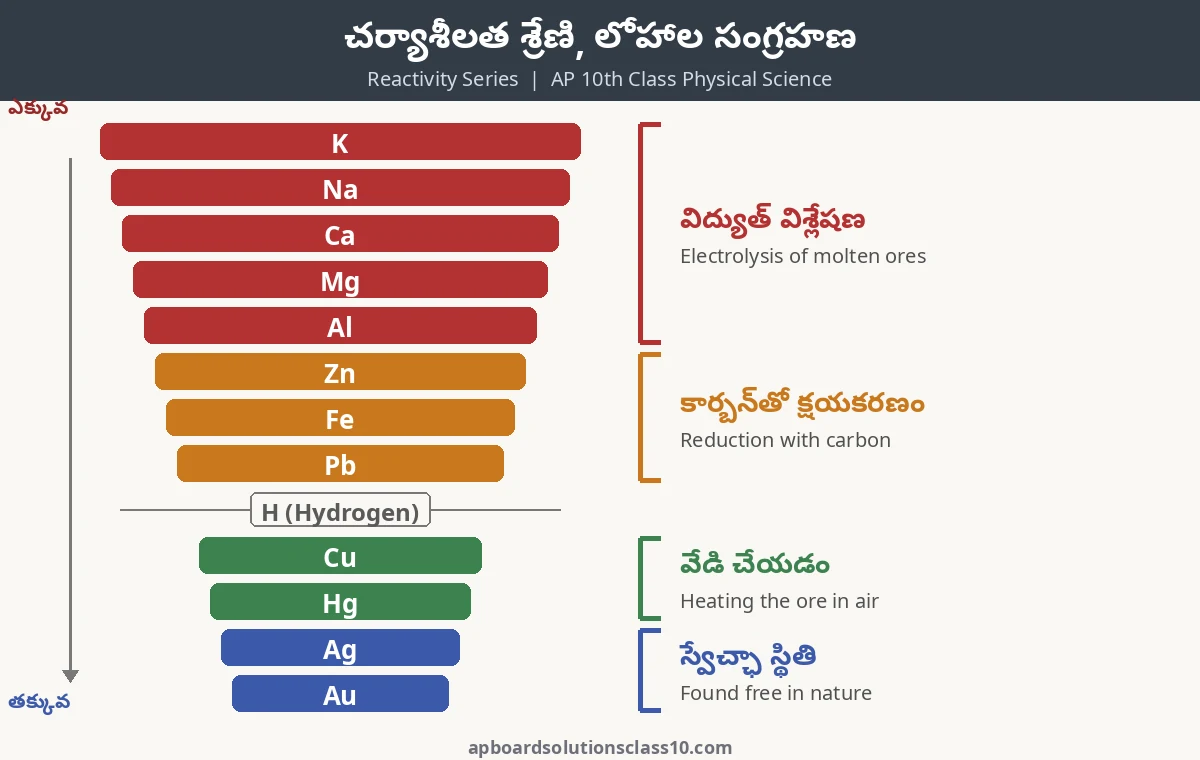
| లోహాలు | చర్యాశీలత | సంగ్రహణ పద్ధతి |
|---|---|---|
| K, Na, Ca, Mg, Al | అత్యధికం | కరిగిన క్లోరైడ్ల విద్యుత్ విశ్లేషణ |
| Zn, Fe, Pb | మధ్యస్థం | భర్జనం లేదా భస్మీకరణం తర్వాత కార్బన్తో క్షయకరణం |
| Hg, Cu | తక్కువ | సల్ఫైడ్ ధాతువును గాలిలో వేడి చేయడం మాత్రమే |
| Ag, Au, Pt | అత్యల్పం | ప్రకృతిలో స్వేచ్ఛా స్థితిలో లభిస్తాయి |
AP 10th Class Metals and Non-metals In-text Questions
1. Give an example of a metal which (i) is a liquid at room temperature (ii) can be easily cut with a knife (iii) is the best conductor of heat (iv) is a poor conductor of heat.
జవాబు చూడండి
2. Explain the meanings of malleable and ductile.
జవాబు చూడండి
Ductile: a metal that can be drawn into thin wires, e.g. gold, copper. Gold is the most ductile metal.
తెలుగులో: ఘనాతవత = రేకులుగా సాగడం, తాంతవత = తీగలుగా సాగడం.
3. Why is sodium kept immersed in kerosene oil?
జవాబు చూడండి
4. Write equations for the reactions of (i) iron with steam (ii) calcium and potassium with water.
జవాబు చూడండి
(ii) Ca(s) + 2H2O(l) → Ca(OH)2(aq) + H2(g)
2K(s) + 2H2O(l) → 2KOH(aq) + H2(g) + heat
తెలుగులో: ఇనుము చల్లని నీటితో కాదు, ఆవిరితో మాత్రమే చర్య జరుపుతుంది. పొటాషియం చర్య ఎంత తీవ్రమంటే హైడ్రోజన్ మంటతో మండుతుంది.
5. Four metals A, B, C and D were added to solutions of iron(II) sulphate, copper(II) sulphate, zinc sulphate and silver nitrate. A displaced only copper; B displaced only iron (no reaction with zinc sulphate); C displaced only silver; D displaced none. (i) Which is the most reactive metal? (ii) What would you observe if B is added to copper(II) sulphate? (iii) Arrange the metals in decreasing order of reactivity.
జవాబు చూడండి
(ii) B is more reactive than iron, so it will also displace copper: the blue colour of the solution fades and reddish-brown copper is deposited.
(iii) B > A > C > D
తెలుగులో: ఏ లోహం ఎన్ని లోహాలను స్థానభ్రంశం చేసిందో చూసి క్రమం రాయండి. ఏదీ చేయని D అతి తక్కువ చురుకైనది.
6. Which gas is produced when dilute hydrochloric acid is added to a reactive metal? Write the reaction of iron with dilute sulphuric acid.
జవాబు చూడండి
7. What would you observe when zinc is added to a solution of iron(II) sulphate? Write the equation.
జవాబు చూడండి
8. (i) Write the electron-dot structures of sodium, oxygen and magnesium. (ii) Show the formation of Na2O and MgO by transfer of electrons. (iii) What are the ions present?
జవాబు చూడండి
(ii) 2Na → 2Na+ + 2e− ; O + 2e− → O2− ; so 2Na+ + O2− → Na2O
Mg → Mg2+ + 2e− ; O + 2e− → O2− ; so Mg2+ + O2− → MgO
(iii) Na2O has Na+ and O2− ions; MgO has Mg2+ and O2− ions.
తెలుగులో: పరీక్షలో బయటి కర్పరం ఎలక్ట్రాన్లను చుక్కలు లేదా ఇంటూ గుర్తులతో చూపించి, బాణంతో బదిలీ చూపించాలి.
9. Why do ionic compounds have high melting points?
జవాబు చూడండి
10. Define: (i) mineral (ii) ore (iii) gangue
జవాబు చూడండి
(ii) Ore: a mineral from which a metal can be extracted profitably.
(iii) Gangue: the impurities such as soil and sand present in an ore.
తెలుగులో: అన్ని ధాతువులు ఖనిజాలే, కానీ అన్ని ఖనిజాలు ధాతువులు కావు.
11. Name two metals which are found in nature in the free state.
జవాబు చూడండి
12. What chemical process is used for obtaining a metal from its oxide?
జవాబు చూడండి
13. Metallic oxides of zinc, magnesium and copper were heated with the metals zinc, magnesium and copper. In which cases will displacement take place?
జవాబు చూడండి
తెలుగులో: చర్యాశీలత: Mg > Zn > Cu.
14. Which metals do not corrode easily?
జవాబు చూడండి
15. What are alloys?
జవాబు చూడండి
AP 10th Class Metals and Non-metals Exercise Questions and Answers
పాఠం చివరి 16 అభ్యాస ప్రశ్నలు. 1 నుంచి 4 బహుళైచ్ఛిక ప్రశ్నలు.
1. Which of the following pairs will give a displacement reaction? (a) NaCl solution and copper metal (b) MgCl2 solution and aluminium metal (c) FeSO4 solution and silver metal (d) AgNO3 solution and copper metal
జవాబు చూడండి
తెలుగులో: రాగి వెండి కంటే చురుకైనది. మిగతా జతల్లో లోహం లవణంలోని లోహం కంటే తక్కువ చురుకైనది.
2. Which of the following methods is suitable for preventing an iron frying pan from rusting? (a) applying grease (b) applying paint (c) applying a coating of zinc (d) all of the above
జవాబు చూడండి
3. An element reacts with oxygen to give a compound with a high melting point. This compound is also soluble in water. The element is likely to be: (a) calcium (b) carbon (c) silicon (d) iron
జవాబు చూడండి
4. Food cans are coated with tin and not with zinc because: (a) zinc is costlier than tin (b) zinc has a higher melting point than tin (c) zinc is more reactive than tin (d) zinc is less reactive than tin
జవాబు చూడండి
5. You are given a hammer, a battery, a bulb, wires and a switch. (a) How could you use them to distinguish between samples of metals and non-metals? (b) Assess the usefulness of these tests.
జవాబు చూడండి
Conductivity test: connect the sample in a circuit with the battery, bulb and switch. If the bulb glows, the sample is a metal; if not, it is a non-metal.
(b) The tests are useful in most cases but not always correct: graphite (a non-metal) conducts electricity, and mercury (a metal) is a liquid that cannot be hammered.
తెలుగులో: ఈ పరీక్షలకు మినహాయింపులు ఉన్నాయని కూడా రాస్తేనే (b) కి పూర్తి మార్కులు.
6. What are amphoteric oxides? Give two examples.
జవాబు చూడండి
Al2O3 + 6HCl → 2AlCl3 + 3H2O
Al2O3 + 2NaOH → 2NaAlO2 + H2O
తెలుగులో: ఆమ్లం, క్షారం రెండింటితోనూ చర్య జరిపేవి ద్విస్వభావ ఆక్సైడ్లు.
7. Name two metals which will displace hydrogen from dilute acids, and two metals which will not.
జవాబు చూడండి
Will not: copper and silver (also gold).
తెలుగులో: చర్యాశీలత శ్రేణిలో హైడ్రోజన్ కంటే పైన ఉన్నవి మాత్రమే హైడ్రోజన్ను విడుదల చేస్తాయి.
8. In the electrolytic refining of a metal M, what would you take as the anode, the cathode and the electrolyte?
జవాబు చూడండి
తెలుగులో: అశుద్ధ లోహం ఆనోడ్ (ధన ధ్రువం), శుద్ధ లోహం కాథోడ్ (ఋణ ధ్రువం). శుద్ధ లోహం కాథోడ్ మీద పేరుకుంటుంది.
9. Pratyush heated sulphur powder on a spatula and collected the gas by inverting a test tube over it. (a) What will be the action of the gas on (i) dry litmus paper (ii) moist litmus paper? (b) Write a balanced equation for the reaction.
జవాబు చూడండి
(a) (i) No change on dry litmus paper. (ii) Moist blue litmus paper turns red, because SO2 forms sulphurous acid with water.
(b) S(s) + O2(g) → SO2(g) ; SO2 + H2O → H2SO3
తెలుగులో: అలోహ ఆక్సైడ్లు ఆమ్ల స్వభావం కలవి.
10. State two ways to prevent the rusting of iron.
జవాబు చూడండి
11. What type of oxides are formed when non-metals combine with oxygen?
జవాబు చూడండి
12. Give reasons: (a) Platinum, gold and silver are used to make jewellery. (b) Sodium, potassium and lithium are stored under oil. (c) Aluminium is a highly reactive metal, yet it is used to make utensils for cooking. (d) Carbonate and sulphide ores are usually converted into oxides during extraction.
జవాబు చూడండి
(b) They are so reactive that they catch fire in air; oil keeps air and moisture away.
(c) Aluminium forms a thin protective layer of aluminium oxide that stops further reaction. It is also light and a good conductor of heat.
(d) It is easier to obtain a metal from its oxide by reduction than from its carbonate or sulphide.
13. Tarnished copper vessels are cleaned with lemon or tamarind juice. Why are these sour substances effective?
జవాబు చూడండి
తెలుగులో: పుల్లని పదార్థాల్లోని ఆమ్లం ఆకుపచ్చ పూతను తొలగిస్తుంది.
14. Differentiate between metals and non-metals on the basis of their chemical properties.
జవాబు చూడండి
Reactive metals displace hydrogen from dilute acids; non-metals do not.
Metals lose electrons and form positive ions; non-metals gain electrons and form negative ions.
Metals form ionic chlorides; non-metals form covalent chlorides.
తెలుగులో: పై “లోహాలు vs అలోహాలు” పట్టిక చూడండి.
15. A man posing as a goldsmith dipped a lady’s dull gold bangles in a solution. They sparkled like new but their weight was reduced. What was the solution?
జవాబు చూడండి
తెలుగులో: ఆక్వా రీజియా (“రాజ ద్రవం”) బంగారం, ప్లాటినంను కూడా కరిగిస్తుంది.
16. Give reasons why copper is used to make hot water tanks and not steel (an alloy of iron).
జవాబు చూడండి
10th Class Metals and Non-metals Important Questions
పాఠ్యపుస్తకం ప్రశ్నలు కాకుండా, పరీక్షల్లో తరచూ వచ్చే రూపంలో మేము తయారు చేసిన ప్రశ్నలు.
1 మార్కు ప్రశ్నలు
1. Which is the most malleable and ductile metal?
జవాబు చూడండి
2. Name a non-metal which is lustrous.
జవాబు చూడండి
3. Name a non-metal which conducts electricity.
జవాబు చూడండి
4. What is the composition of solder?
జవాబు చూడండి
తెలుగులో: తక్కువ ద్రవీభవన స్థానం కాబట్టి విద్యుత్ తీగలు అతకడానికి వాడతారు.
5. What is the chemical name of the green coating formed on copper?
జవాబు చూడండి
2 మార్కుల ప్రశ్నలు
1. What is the difference between roasting and calcination? Give one equation each.
జవాబు చూడండి
Calcination: heating a carbonate ore strongly in limited air: ZnCO3 → ZnO + CO2
తెలుగులో: భర్జనం = సల్ఫైడ్ + అధిక గాలి; భస్మీకరణం = కార్బొనేట్ + తక్కువ గాలి.
2. What is the thermit reaction? Where is it used?
జవాబు చూడండి
3. Why do ionic compounds conduct electricity in the molten state or in solution but not in the solid state?
జవాబు చూడండి
4. Why is hydrogen gas usually not evolved when a metal reacts with nitric acid?
జవాబు చూడండి
4 మార్కుల ప్రశ్నలు
1. Explain the electrolytic refining of copper with a labelled diagram.
జవాబు చూడండి
తెలుగులో: చిత్రంలో ఆనోడ్ (అశుద్ధ రాగి), కాథోడ్ (శుద్ధ రాగి), CuSO4 ద్రావణం, ఆనోడ్ మడ్ గుర్తించాలి.
2. Describe an activity to show that both air and water are needed for iron to rust.
జవాబు చూడండి
తెలుగులో: మూడు పరీక్ష నాళికల చిత్రం గీసి, దేనిలో తుప్పు పట్టిందో రాయండి.
3. How are metals of medium reactivity extracted? Explain with the example of zinc.
జవాబు చూడండి
Metals and Non-metals క్విజ్ — 10 ప్రశ్నలు
జవాబు చూసి, మీది సరైతేనే టిక్ పెట్టండి. కింది బార్లో 10 కి మీ స్కోర్ కనిపిస్తుంది.
1. Metal which is liquid at room temperature:
(A) sodium (B) mercury (C) lead (D) silver [1 మార్కు]
జవాబు చూడండి
2. Best conductor of heat:
(A) copper (B) aluminium (C) silver (D) iron [1 మార్కు]
జవాబు చూడండి
3. Non-metal that conducts electricity:
(A) sulphur (B) iodine (C) graphite (D) phosphorus [1 మార్కు]
జవాబు చూడండి
4. Sodium is stored in:
(A) water (B) alcohol (C) kerosene (D) air [1 మార్కు]
జవాబు చూడండి
5. Which oxide is amphoteric?
(A) Na2O (B) CaO (C) Al2O3 (D) SO2 [1 మార్కు]
జవాబు చూడండి
6. Coating iron with zinc is called:
(A) anodising (B) galvanisation (C) alloying (D) refining [1 మార్కు]
జవాబు చూడండి
7. Aqua regia is a mixture of conc. HCl and conc. HNO3 in the ratio:
(A) 1 : 3 (B) 3 : 1 (C) 1 : 1 (D) 2 : 1 [1 మార్కు]
జవాబు చూడండి
8. Heating a carbonate ore in limited air is called:
(A) roasting (B) calcination (C) smelting (D) refining [1 మార్కు]
జవాబు చూడండి
9. Which metal is found in the free state?
(A) sodium (B) iron (C) gold (D) zinc [1 మార్కు]
జవాబు చూడండి
10. Brass is an alloy of:
(A) copper and tin (B) copper and zinc (C) lead and tin (D) iron and nickel [1 మార్కు]
జవాబు చూడండి
ఈ పాఠంలో మార్కులు ఎక్కడ పోతాయి
- భర్జనం (roasting), భస్మీకరణం (calcination) తారుమారు చేయడం. సల్ఫైడ్కు భర్జనం, కార్బొనేట్కు భస్మీకరణం.
- విద్యుత్ విశ్లేషణ శుద్ధిలో శుద్ధ లోహాన్ని ఆనోడ్గా రాయడం. శుద్ధ లోహం ఎప్పుడూ కాథోడ్.
- అయాన్ల ఆవేశాలు (Na+, O2−, Mg2+) రాయకపోవడం.
- ఇనుము చల్లని నీటితో చర్య జరుపుతుందని రాయడం. ఇనుము ఆవిరితో మాత్రమే చర్య జరుపుతుంది.
- “తుప్పు పట్టడానికి గాలి లేదా నీరు చాలు” అని రాయడం. రెండూ కావాలి.
తర్వాత ఏం చదవాలి
- AP 10th Class Acids Bases and Salts Solutions — పాఠం 2 జవాబులు
- 10th Class Chemistry Chapter 4 Notes in Telugu — తర్వాతి పాఠం కార్బన్, దాని సమ్మేళనాలు
- AP 10th Class SA1 Physical Science Question Paper 2026-27 — SA1 సాధన పేపర్
- 10th Class Chemistry Important Questions 2026 — అన్ని రసాయన శాస్త్ర పాఠాలు
FAQs
AP 10th Class Metals and Non-metals పాఠం ఏ నెలలో చెబుతారు?
AP SCERT ఉపాధ్యాయ కరదీపిక ప్రకారం ఆగస్టులో. భౌతిక శాస్త్రం పుస్తకంలో ఇది మూడో పాఠం.
ఈ పాఠంలో ఎన్ని ప్రశ్నలు ఉన్నాయి?
పాఠం చివర 16 అభ్యాస ప్రశ్నలు, పాఠం మధ్యలో 15 In-text ప్రశ్నలు. అన్నింటికీ జవాబులు ఈ పేజీలో ఉన్నాయి.
చర్యాశీలత శ్రేణి ఎలా గుర్తుంచుకోవాలి?
K, Na, Ca, Mg, Al, Zn, Fe, Pb, H, Cu, Hg, Ag, Au. పైన ఉన్నది కింద ఉన్నదాన్ని స్థానభ్రంశం చేస్తుంది. హైడ్రోజన్ కంటే పైవి మాత్రమే ఆమ్లాల నుంచి హైడ్రోజన్ విడుదల చేస్తాయి.
ఖనిజానికి, ధాతువుకు తేడా ఏమిటి?
భూమిలో సహజంగా దొరికే సమ్మేళనం ఖనిజం. లాభదాయకంగా లోహం తీయగలిగే ఖనిజం మాత్రమే ధాతువు.
అల్యూమినియం చురుకైనదైనా ఎందుకు త్వరగా పాడవదు?
దాని ఉపరితలం మీద సన్నని అల్యూమినియం ఆక్సైడ్ పొర ఏర్పడి లోపలి లోహాన్ని కాపాడుతుంది.
అయానిక సమ్మేళనాల ధర్మాలు ఏమిటి?
ఘన పదార్థాలు, అధిక ద్రవీభవన, బాష్పీభవన స్థానాలు, నీటిలో కరుగుతాయి, కిరోసిన్, పెట్రోల్లో కరగవు, ద్రవ స్థితిలో లేదా ద్రావణంలో విద్యుత్ వాహకాలు.
మిశ్రలోహాలు ఎందుకు తయారు చేస్తారు?
లోహపు ధర్మాలను మెరుగుపరచడానికి. ఉదాహరణకు స్టెయిన్లెస్ స్టీల్ తుప్పు పట్టదు, సోల్డర్ తక్కువ ఉష్ణోగ్రతకే కరుగుతుంది.
ఈ జవాబులు తెలుగు మీడియం విద్యార్థులకు పనికొస్తాయా?
అవును. ప్రతి జవాబు కింద తెలుగు వివరణ ఉంది. సమీకరణాలు రెండు మీడియంలలోనూ ఒకటే.
SA1 లో ఈ పాఠం నుంచి ఎలాంటి ప్రశ్నలు వస్తాయి?
కారణాలు చెప్పే ప్రశ్నలు, స్థానభ్రంశ చర్యలు, అయానిక సమ్మేళనాల ఏర్పాటు, విద్యుత్ విశ్లేషణ శుద్ధి చిత్రం, తుప్పు కృత్యం ఎక్కువగా వస్తాయి. SA1 పాఠాల జాబితా AP SA1 Syllabus 2026-27 లో ఉంది.
తర్వాతి పాఠం జవాబులు ఎప్పుడు?
పుస్తకం క్రమంలో Carbon and its Compounds జవాబుల పేజీ తర్వాత వస్తుంది.
Official Sources
పాఠాల జాబితా, నెలవారీ ప్రణాళిక: AP SCERT పదో తరగతి భౌతిక శాస్త్రం ఉపాధ్యాయ కరదీపిక (Teacher’s Handbook), పాఠశాల విద్యాశాఖ ఆంధ్రప్రదేశ్. పాఠ్యపుస్తకాలు పాఠశాల విద్యాశాఖ సైట్లో లభిస్తాయి. జవాబులు మా సొంత మాటల్లో రాశాం.