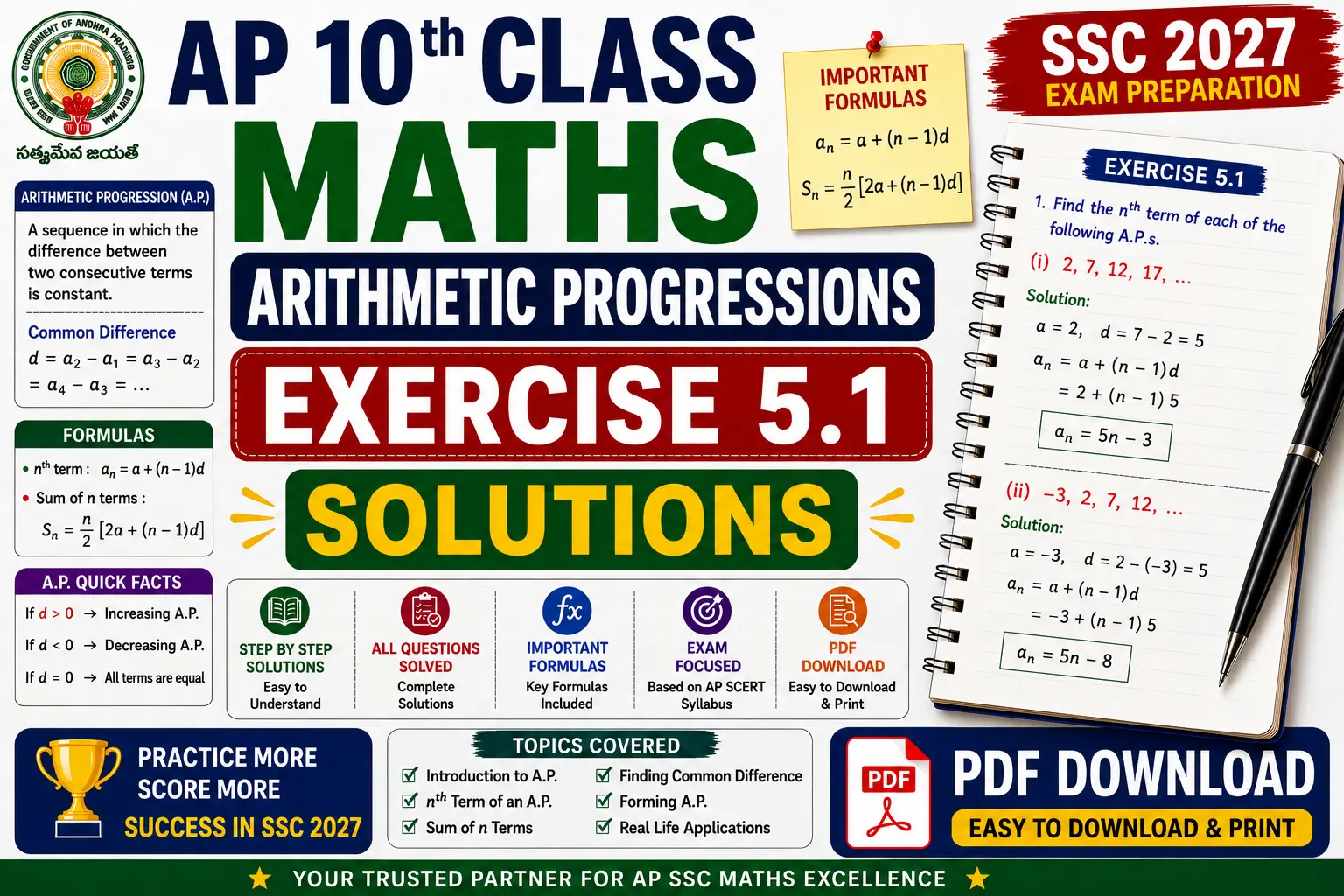
AP 10th Class Maths Chapter 5 – Arithmetic Progressions Exercise 5.1 Solutions
Chapter 5 లో మొదటిసారి Arithmetic Progression (AP) అనే భావనని పరిచయం చేస్తారు. Exercise 5.1 పూర్తిగా ఒక list of numbers AP అవునో కాదో గుర్తించడం, common difference కనుక్కోవడం మీద ఆధారపడి ఉంటుంది.
Key Concept: AP ని ఎలా గుర్తించాలి?
ఒక సంఖ్యల జాబితా (list) Arithmetic Progression అవ్వాలంటే, వరుస పదాల మధ్య తేడా (common difference, d) ఎప్పుడూ ఒకేలా ఉండాలి:
d = a₂ − a₁ = a₃ − a₂ = a₄ − a₃ = …
ఇది ప్రతిసారీ సమానంగా వస్తే, అది AP. ఏ ఒక్కసారైనా తేడా వస్తే, అది AP కాదు.
Question 1.
Which of the following situations make an Arithmetic Progression, and why?
i) టాక్సీ ఫేర్ — మొదటి km కి ₹15, తర్వాతి ప్రతి km కి ₹8
15, 15+8=23, 23+8=31, … అవును, ఇది AP — ప్రతి తర్వాతి పదం, ముందు పదానికి 8 కలపడం ద్వారా వస్తుంది (d = 8).
ii) Vacuum pump ప్రతిసారీ మిగిలిన గాలిలో 1/4 వంతు తీసేయడం
మొదట్లో గాలి = V. మొదటిసారి తీశాక మిగిలేది = (3/4)V. రెండోసారి తీశాక = (3/4)²V … కాదు, ఇది AP కాదు — ఇక్కడ ప్రతిసారీ multiplication జరుగుతుంది (గుణకారం), addition కాదు.
iii) బావి తవ్వకం ఖర్చు — మొదటి మీటర్కి ₹150, తర్వాతి ప్రతి మీటర్కి ₹50 పెరుగుదల
150, 150+50=200, 200+50=250, … అవును, ఇది AP (d = 50).
iv) బ్యాంక్ లో ₹10,000, 8% compound interest
10000(1+8/100), 10000(1+8/100)², 10000(1+8/100)³, … కాదు, ఇది AP కాదు — compound interest లో exponential growth ఉంటుంది, ప్రతి పదం constant గా పెరగదు.
Question 2.
Write the first four terms of the AP when first term a and common difference d are given.
AP ఫార్ములా: a, a+d, a+2d, a+3d, …
i) a = 10, d = 10 → 10, 20, 30, 40
ii) a = −2, d = 0 → −2, −2, −2, −2
iii) a = 4, d = −3 → 4, 1, −2, −5
iv) a = −1, d = 1/2 → −1, −1/2, 0, 1/2
v) a = −1.25, d = −0.25 → −1.25, −1.50, −1.75, −2.00
Question 3.
Find the first term and common difference for the following APs:
i) 3, 1, −1, −3, … → a = 3, d = 1−3 = −2
ii) −5, −1, 3, 7, … → a = −5, d = −1−(−5) = 4
iii) 1/3, 5/3, 9/3, 13/3, … → a = 1/3, d = 5/3−1/3 = 4/3
iv) 0.6, 1.7, 2.8, 3.9, … → a = 0.6, d = 1.7−0.6 = 1.1
Question 4.
Which of the following are APs? If yes, find the common difference d and write three more terms.
i) 2, 4, 8, 16, … a₂−a₁=2, a₃−a₂=4, a₄−a₃=8 — తేడాలు సమానం కాదు. AP కాదు.
ii) 2, 5/2, 3, 7/2, … తేడాలన్నీ 1/2. AP, d=1/2. తర్వాతి 3 పదాలు: 4, 9/2, 5
iii) −1.2, −3.2, −5.2, −7.2, … తేడాలన్నీ −2. AP, d=−2. తర్వాతి 3 పదాలు: −9.2, −11.2, −13.2
iv) −10, −6, −2, 2, … తేడాలన్నీ 4. AP, d=4. తర్వాతి 3 పదాలు: 6, 10, 14
v) 3, 3+√2, 3+2√2, 3+3√2, … తేడాలన్నీ √2. AP, d=√2. తర్వాతి 3 పదాలు: 3+4√2, 3+5√2, 3+6√2
vi) 0.2, 0.22, 0.222, 0.2222, … తేడాలు: 0.02, 0.002, 0.0002 — సమానం కాదు. AP కాదు.
vii) 0, −4, −8, −12, … తేడాలన్నీ −4. AP, d=−4. తర్వాతి 3 పదాలు: −16, −20, −24
viii) −1/2, −1/2, −1/2, −1/2, … తేడాలన్నీ 0. AP, d=0. తర్వాతి 3 పదాలు: −1/2, −1/2, −1/2
ix) 1, 3, 9, 27, … తేడాలు: 2, 6, 18 — సమానం కాదు. AP కాదు.
x) a, 2a, 3a, 4a, … తేడాలన్నీ a. AP, d=a. తర్వాతి 3 పదాలు: 5a, 6a, 7a
xi) a, a², a³, a⁴, … తేడాలు: a²−a, a³−a², a⁴−a³ — ఇవి సాధారణంగా సమానం కావు (a=1 తప్ప). AP కాదు.
xii) √2, √8, √18, √32, … ఇది √2, 2√2, 3√2, 4√2 గా simplify అవుతుంది. తేడాలన్నీ √2. AP, d=√2. తర్వాతి 3 పదాలు: √50, √72, √98
xiii) √3, √6, √9, √12, … తేడాలు (√6−√3), (√9−√6), (√12−√9) — ఇవి సంఖ్యాపరంగా సమానం కావు. AP కాదు.
xiv) 1², 3², 5², 7², … 1, 9, 25, 49 → తేడాలు: 8, 16, 24 — సమానం కాదు. AP కాదు.
xv) 1², 5², 7², 73 1, 25, 49, 73 → తేడాలు: 24, 24, 24 — అన్నీ సమానం! AP, d=24. తర్వాతి 3 పదాలు: 73+24=97, 97+24=121, 121+24=145
(గమనిక: ఈ ప్రశ్నలో చివరి పదం 7² కాదు, కేవలం 73 అనే plain సంఖ్య — ఇది ఒక tricky question, జాగ్రత్తగా చదవాలి)
ఈ Exercise నుండి గుర్తుంచుకోవాల్సినవి
- AP identify చేయడానికి, కనీసం మొదటి 3-4 తేడాలు (differences) calculate చేసి సరిపోల్చుకోవాలి
- Multiplication/Division ద్వారా వచ్చే sequences (compound interest, repeated fraction removal వంటివి) సాధారణంగా AP కావు — అవి Geometric Progression కావొచ్చు
- √2, √8, √18 లాంటి surds ని ముందుగా simplify చేస్తే, అవి కూడా AP పాటర్న్ చూపించవచ్చు (√8=2√2, √18=3√2 అని గుర్తుంచుకోండి)
- Squares (1², 3², 5²…) సాధారణంగా AP ఏర్పరచవు, ఎందుకంటే వాటి తేడాలు పెరుగుతూ ఉంటాయి
Frequently Asked Questions (FAQs)
1. Arithmetic Progression (AP) అంటే ఏమిటి? వరుస పదాల మధ్య తేడా ఎప్పుడూ స్థిరంగా (constant) ఉండే సంఖ్యల జాబితా.
2. Common Difference (d) ని ఎలా కనుక్కోవాలి? d = (ఏదైనా పదం) − (దానికి ముందు ఉన్న పదం). ఉదాహరణకు d = a₂ − a₁.
3. Compound Interest సీక్వెన్స్ ఎందుకు AP కాదు? ఎందుకంటే ఇందులో ప్రతి సంవత్సరం మొత్తం స్థిరంగా పెరగదు, ఇది గుణకార (multiplicative) పద్ధతిలో పెరుగుతుంది — ఇది Geometric Progression కి దగ్గరగా ఉంటుంది.
సంబంధిత ఆర్టికల్స్
AP 10th Class Maths Solutions – Complete Resource Hub 
AP 10th Class Maths Chapter 1 – Real Numbers Exercise 1.1 Solutions
AP 10th Class Maths Real Numbers Optional Exercise Solutions 1.2
AP 10th Class Maths Notes – Real Numbers
AP 10th Class Maths Polynomials Exercise 2.1 Solutions
AP 10th Class Maths Polynomials Exercise 2.2 Solutions
AP 10th Class Maths Pair of Linear Equations Exercise 3.1 Solutions
AP 10th Class Maths Pair of Linear Equations Exercise 3.2 Solutions
AP 10th Class Maths Pair of Linear Equations Exercise 3.3 Solutions
AP 10th Class Maths Quadratic Equations Exercise 4.1 Solutions
AP 10th Class Maths Quadratic Equations Exercise 4.2 Solutions
AP 10th Class Maths Quadratic Equations Exercise 4.3 Solutions
AP 10th Class Maths Arithmetic Progressions Exercise 5.2 Solutions
AP 10th Class Maths Arithmetic Progressions Exercise 5.3 Solutions
AP 10th Class Maths Arithmetic Progressions Exercise 5.4 Solutions